The Oldest 'Odin' Ever Found: What the Vindelev Hoard Tells Us About the Historical Woden
FIELD REPORT , Vindelev, Jutland
In 2020, metal detectorists found a remarkable gold hoard near Vindelev, about eight kilometres northeast of Jelling in Denmark. The discovery contained almost 800 grams of gold and ranks among the largest and richest Migration Period hoards ever found in Denmark.
One object changed the discussion of historical Odin.
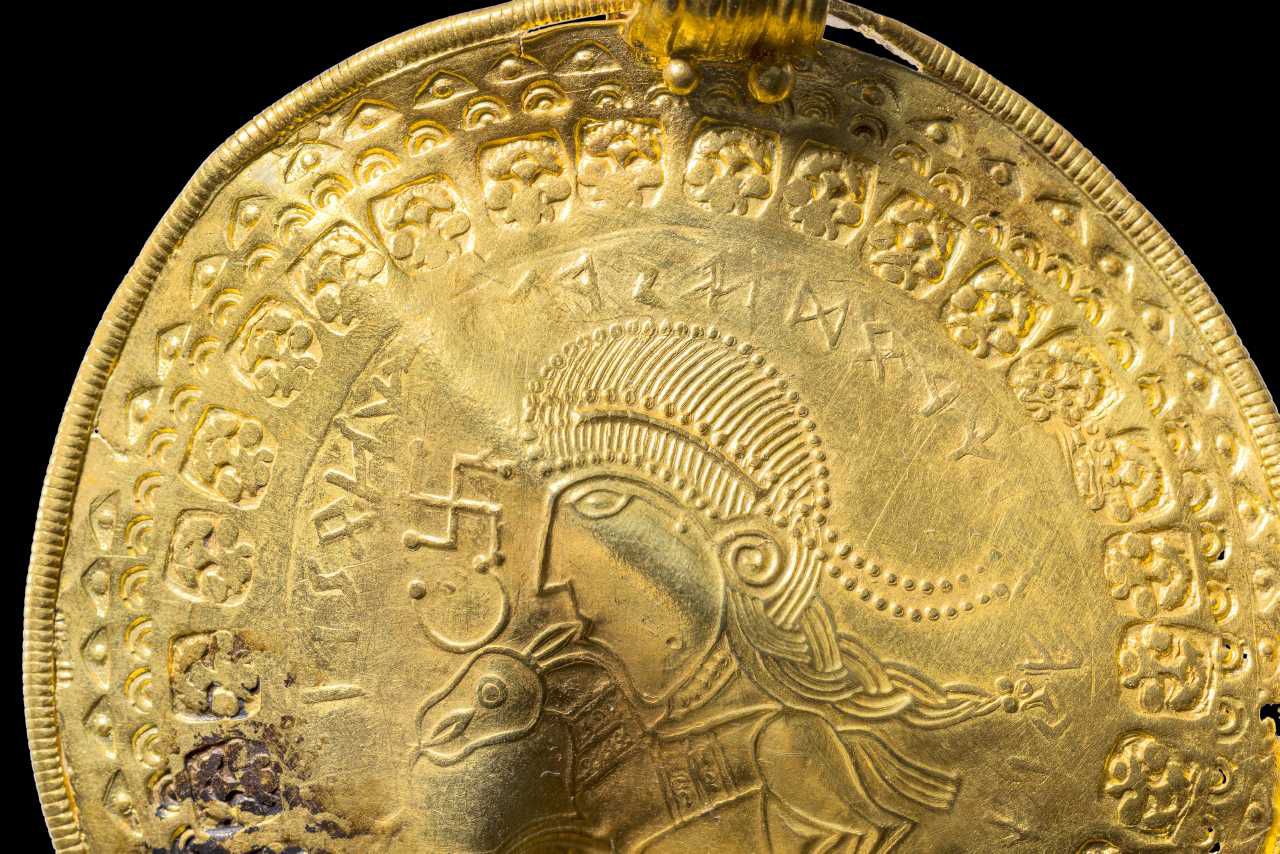
A thin gold bracteate from the hoard carries an Elder Futhark inscription generally reconstructed as:
iz Wōd[a]nas weraz
The usual translation is:
“He is Wodan’s man.”
The inscription is important because it provides the earliest secure written occurrence of the name associated with Wodan, the Germanic figure later known in Old Norse as Óðinn or Odin. It pushes the written evidence back roughly 150 years before the previously recognised examples from the sixth century.
That does not prove that a historical Odin has been found. It does something more precise. It places the name Wodan in the right cultural world, and in the right broad period, for the historical Woden investigation.
01 , THE FIND: GOLD FROM A CHANGING WORLD
The Vindelev Hoard was discovered in a field near Jelling in December 2020. The hoard contains 23 gold objects, including:
- Four Roman gold medallions.
- Thirteen Nordic gold bracteates.
- A large pendant with glass inlays.
- A gold scabbard fitting.
- Additional decorated gold pieces and fragments.
The objects belong broadly to the late Roman and Germanic Iron Ages, within the period commonly called the Migration Period. This was a time of political change across Europe. Roman authority was weakening in the West. Communities, families, warriors, and ruling houses moved through a landscape of shifting alliances.
The hoard reflects that wider world. Roman objects reached Scandinavia through long-distance exchange, diplomacy, gift-giving, or military connections. Local craftsmen transformed Roman visual language into new northern forms.
The Vindelev material therefore belongs to more than a local Danish story. It belongs to the wider Germanic Migration Period, when names, symbols, objects, and political traditions travelled across Europe.
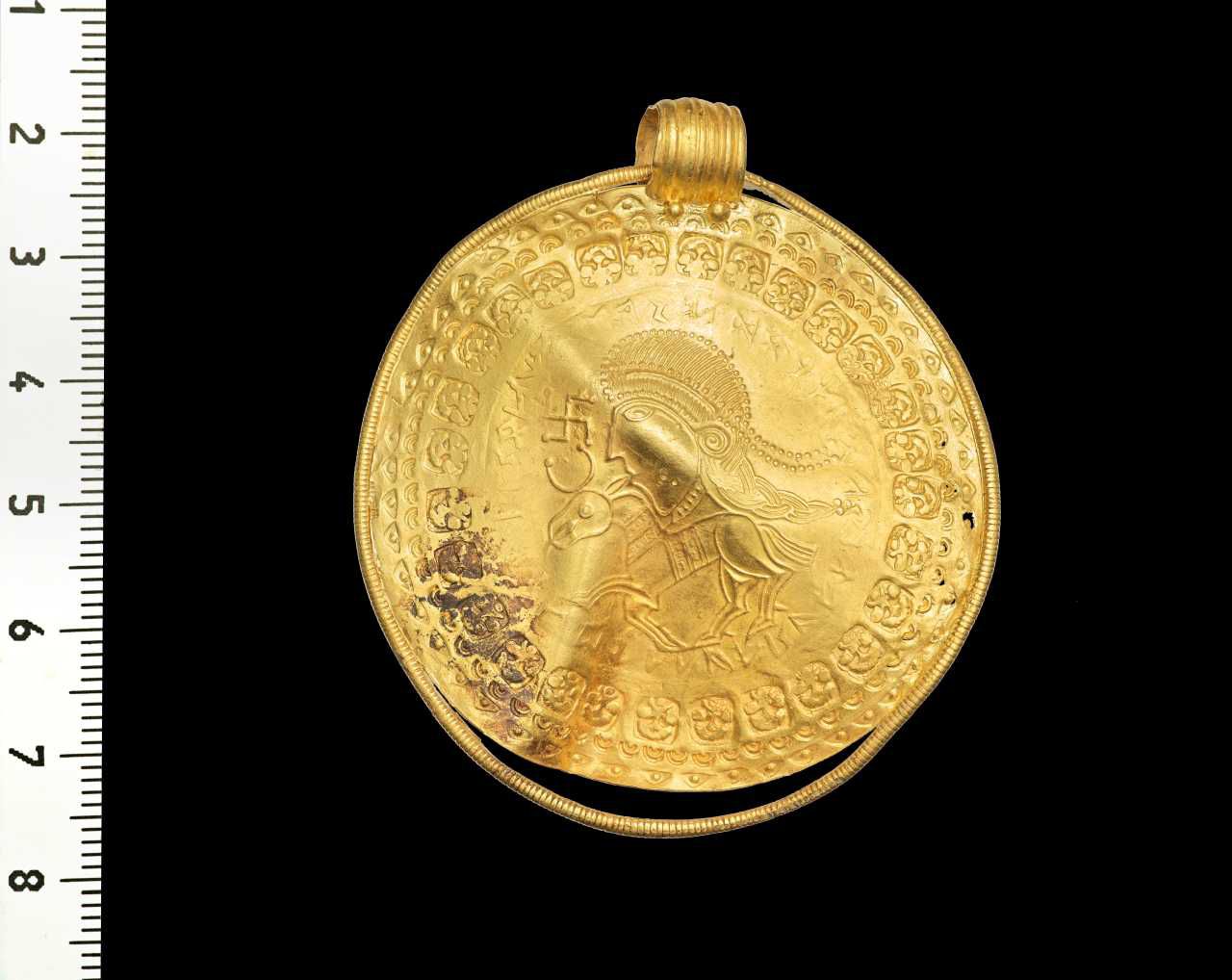
The inscribed bracteate is approximately 5.2 centimetres in diameter. Object record: National Museum of Denmark.
02 , WHAT IS A BRACTEATE?
A bracteate is a thin, stamped gold medallion. Unlike a coin, it was not normally intended as currency. It was more often worn as jewellery, probably by people of high social status.
The form developed partly from Roman medallions. Roman rulers used large gold medallions as prestigious gifts. In Scandinavia, local elites adopted and reworked this form during the fourth and fifth centuries.
A bracteate could communicate several things at once:
- Wealth.
- Political rank.
- Religious affiliation.
- Family identity.
- Connection to a powerful ruler or supernatural patron.
The images are often difficult to interpret. They include human heads, animals, horses, birds, gestures, and abstract motifs. Some have runic inscriptions. Others contain signs that may have carried meaning to their original viewers but cannot now be read with certainty.
The Vindelev bracteate is especially valuable because its image and inscription can be examined together. It depicts a human figure with a diadem and a braid, positioned above a four-legged animal. A long runic inscription circles the image.
The figure may look like Odin to a modern viewer. But appearance alone cannot settle the matter.
03 , THE INSCRIPTION: “WODAN’S MAN”
The inscription is written in an early Germanic language usually called Proto-Norse or Old Norse’s linguistic predecessor. It uses the Elder Futhark, the older runic alphabet used before the development of the Younger Futhark of the Viking Age.
The full inscription is worn and difficult to read. The reading is therefore not a simple matter of matching modern letters to ancient ones. It requires the comparison of rune forms, grammar, vocabulary, inscriptional habits, and related examples.
Runologist Lisbeth M. Imer of the National Museum of Denmark and linguist Krister S. K. Vasshus published the detailed study in 2023. Their article, “Lost in transition: The runic bracteates from the Vindelev hoard,” examines the inscription and reconstructs its final sequence as a phrase meaning:
“He or who is Óðin’s man.”
The important word is the possessive form of Wodan’s name. The phrase does not simply say “Wodan.” It describes someone in relation to him.
That distinction matters.
The inscription may identify the person shown on the bracteate as a man under Wodan’s protection, a ruler associated with Wodan, or an elite figure claiming a special bond with the god. The text does not require the depicted person to be Wodan himself.
This is why Imer and Vasshus argue that the wording favours the interpretation of a king or ruler, rather than a direct portrait of Odin.
04 , GOD OR KING? THE CENTRAL DEBATE
Many bracteates have traditionally been interpreted as images of Odin. Some show a human figure with an animal. Others appear to depict healing, sacrifice, magic, or transformation. These interpretations have shaped the study of early Norse mythology history.
But the Vindelev inscription introduces a useful test.
If the image shows Odin, why describe the figure as “Wodan’s man”? The phrase seems to distinguish between the individual represented and the god named in the inscription.
The alternative interpretation is that the bracteate depicts a human ruler connected to Wodan. The animal and surrounding imagery may express divine protection, royal authority, or a mythic model of leadership.
This reading fits the social structure of the Migration Period. Power was not organised only through fixed institutions. It depended heavily on personal bonds between a leader and his followers. A king or warlord offered protection, wealth, identity, and access to prestige. Warriors responded with loyalty and service.
“Wodan’s man” could therefore echo a familiar political relationship. The ruler was not merely a private worshipper. He was presented as someone who belonged to Wodan’s sphere of power.
The inscription joins religious language and political language. That combination is not surprising. In early Germanic societies, kingship, ancestry, warfare, and divine favour were closely connected.
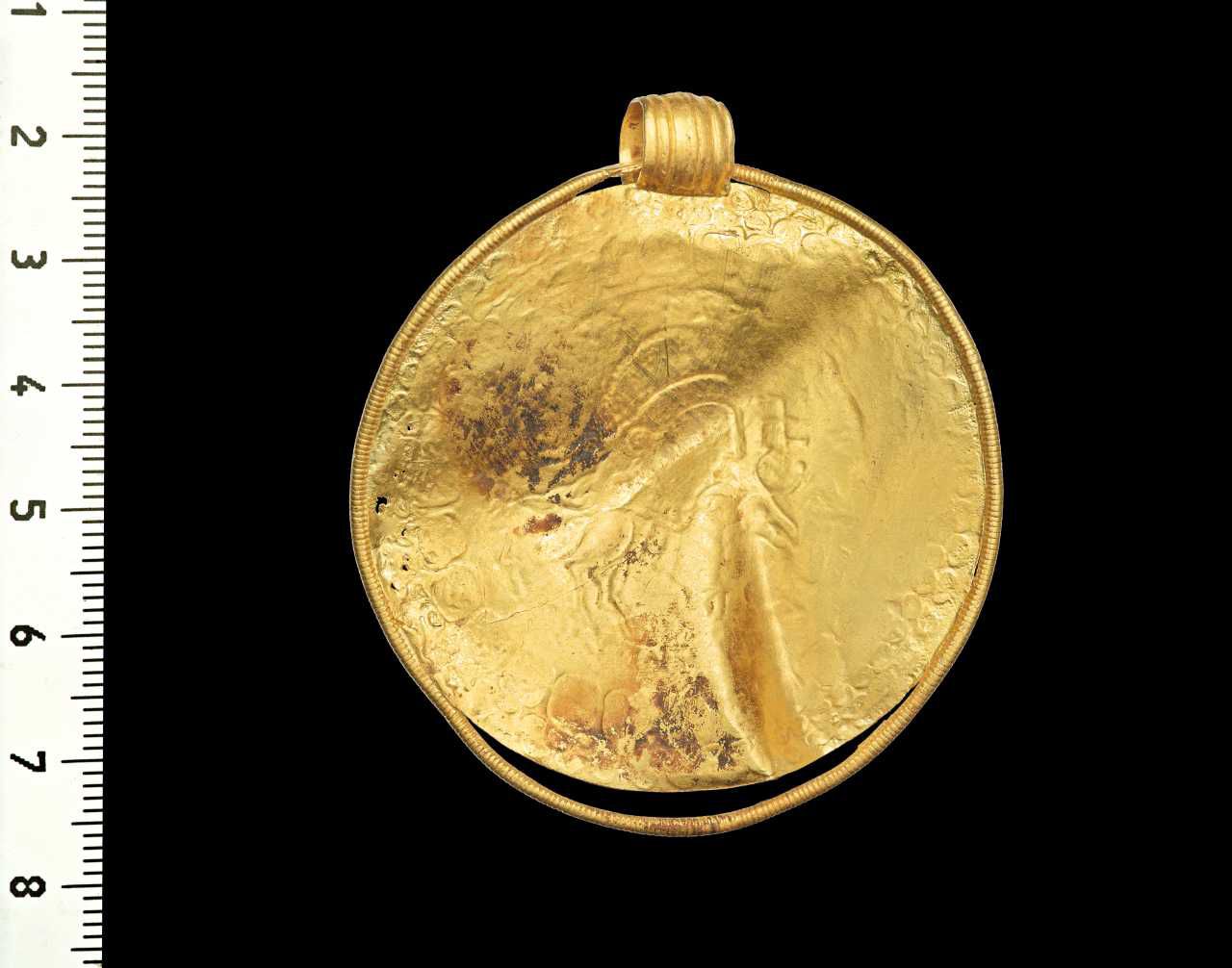
The reverse of the object shows its thin stamped construction and suspension loop. The National Museum records the piece as bracteate IK 738.
05 , WHY THIS MATTERS FOR HISTORICAL WODEN
The Vindelev bracteate does not reveal a biography. It does not name a human king with certainty. It does not establish that the later stories about Odin preserve a complete historical record.
Its value is more specific.
The genealogical traditions of Anglo-Saxon and Scandinavian rulers place Woden near the beginning of royal family lines. In these traditions, Woden functions as an ancestral figure. The literary sources are much later than the Migration Period, so they cannot be treated as direct eyewitness records.
But the Vindelev evidence shows that the name Wodan was already attached to elite identity and authority in the early fifth century.
That is exactly the kind of setting in which an ancestral ruler could become attached to a divine or semi-divine tradition:
- A powerful leader gains political importance.
- His name becomes linked to a royal lineage.
- His reputation travels with migrating families and warrior groups.
- Later communities preserve the memory in genealogical and religious forms.
- The remembered person becomes increasingly difficult to separate from the god.
This is a hypothesis, not a conclusion. The bracteate does not demonstrate that Wodan began as one identifiable historical person. It does show that Wodan was already present in a world of rulers, retinues, wealth, and inherited authority centuries before the Viking Age.
That chronological fit is significant.

The Vindelev evidence must be considered within the wider networks of migration, exchange, and political memory across Northern Europe.
06 , THE STRÄNGNÄS COMPANION
The Vindelev inscription is not entirely isolated. A small stone from Strängnäs in Sweden bears the sequence:
…rilaʀ • wodinʀ…
The inscription is generally associated with the early Germanic Iron Age and is usually dated around the fifth century. It contains the form Wodinʀ, which is linguistically related to the later name Odin.
The Strängnäs stone was formally published by Helmer Gustavson and Jan O. H. Swantesson in Fornvännen in 2011. Its discovery circumstances were poorly documented, which has made it more debated than the Vindelev bracteate. Geological, technical, runological, and linguistic arguments have nevertheless been used in support of its authenticity.
It should be treated as a companion piece, not as an identical kind of evidence.
The Strängnäs inscription is fragmentary and difficult to interpret in context. Vindelev provides a clearer object history, a datable hoard context, a longer inscription, and a meaningful grammatical phrase. Together, the two pieces suggest that forms of the Wodan name were circulating in Scandinavia during the Migration Period.
The evidence is stronger in combination than in isolation.
VERDICT , AN EARLY NAME, A POLITICAL WORLD, AND AN OPEN QUESTION
The Vindelev Hoard gives us the earliest secure written reference to Wodan or Odin currently known. The inscription iz Wōd[a]nas weraz is best translated as “He is Wodan’s man,” though the exact syntax and damaged sections require continued study.
The figure on the bracteate may be Wodan. The wording, however, more likely presents a king, chieftain, or elite ruler as someone connected to Wodan.
For the historical Woden investigation, the result is substantial but limited:
- It confirms that the Wodan name was in use by the early fifth century.
- It places that name among Migration Period elites.
- It connects divine identity with kingship and personal loyalty.
- It fits the broad chronological setting of later ancestral traditions.
- It does not identify a historical Woden with certainty.
- It does not prove that Norse mythology preserves a simple biography.
The strongest conclusion is not that the case is closed. It is that the case has gained an important primary source.
Prefer convergence over spectacle. Compare the object, the language, the society, and the later memory. Then revise the argument when stronger evidence appears.
SOURCES AND FURTHER READING
- National Museum of Denmark: Vindelev bracteate IK 738
- Lisbeth M. Imer and Krister S. K. Vasshus, “Lost in transition: The runic bracteates from the Vindelev hoard,” NOWELE: North-Western European Language Evolution 76, no. 1 (2023), pp. 60–99.
- Museum Kongernes Jelling: The Gold Treasure from Vindelev
- Helmer Gustavson and Jan O. H. Swantesson, “Strängnäs, Skramle och Tomteboda: tre urnordiska runinskrifter,” Fornvännen 106 (2011), pp. 306–321.
- Vejlemuseerne: The Vindelev Hoard
- Explore the wider WodensMan investigation.