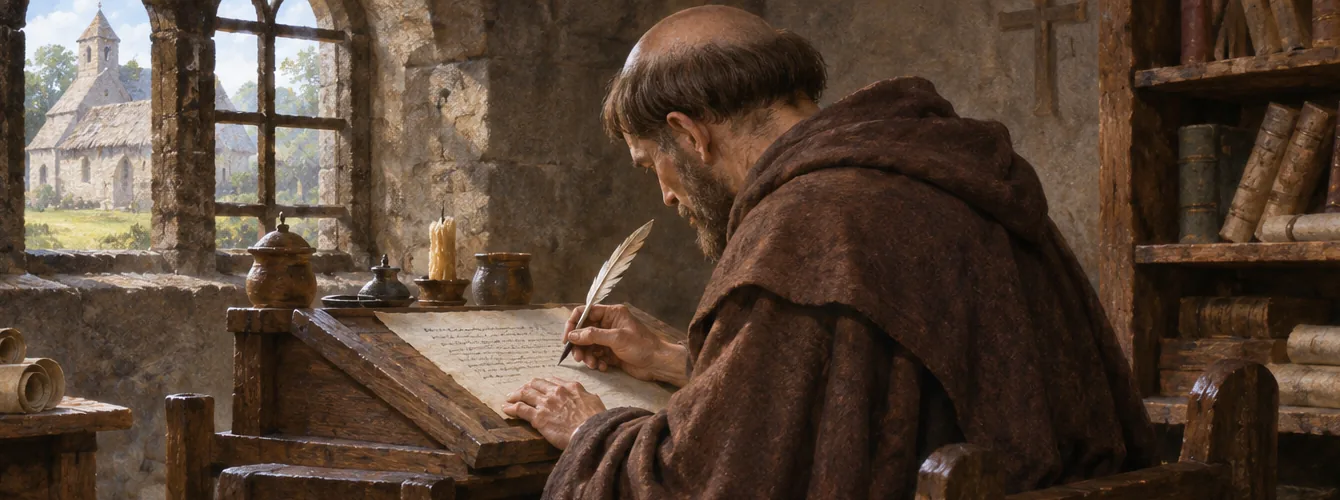
Bede’s wording is ancestral: in Ecclesiastical History I.15, Woden stands in the pedigree of Hengist and Horsa. Bede connects his stock with royal houses, making this passage an important witness to Woden’s place in early English ancestral memory. [1]
The history and its early witnesses
Bede completed his Historia ecclesiastica gentis Anglorum in 731. His account describes the fifth-century arrival of Germanic groups in Britain. Cambridge University Library dates the Moore Bede manuscript to around 737 or shortly after, placing an important surviving witness close to the work’s completion. These dates let us follow the preservation of the account as well as the earlier world it describes. [2]
In Book I.15, Bede introduces the Angles, Saxons and Jutes, the invitation to warriors from across the sea, and the figures Hengist and Horsa. A. M. Sellar’s translation traces the brothers’ ancestry through Victgilsus, Vitta and Vecta to Woden. Reading the sequence in full gives us named generations and their order. [1]
What did Bede call Woden?
The crucial phrase connects the origin of royal stock in several provinces to Woden. Hengist and Horsa are the commanders in this part of the narrative; Woden appears earlier in their ancestry. Bede’s description in this passage is a genealogical one. That gives our investigation a precise point of entry: Woden as an ancestor remembered across ruling houses. [1]
A pedigree joins people through descent while communicating continuity and belonging. Its named generations can be compared with other lists, and its place within the work helps explain how ancestral authority was presented to readers.
Royal ancestry and political memory
Charlotte Behr’s study of early Kentish kingship examines Bede’s account as a reflection of eighth-century ideas about Migration Period origins. Her interpretation connects dynastic identity with material culture and the veneration of Woden in Kent. This provides one scholarly reading of how genealogy, rulership and remembered origins worked together. [4]
For WodensMan, the ancestral record is part of the historical evidence. The research compares names and sequences, the dates of the witnesses, their relationships and the political settings in which they were preserved.
How the name travelled through Christian history
Woden continued to appear in royal genealogical writing after the conversion of Anglo-Saxon kingdoms to Christianity. Craig R. Davis examines how earlier divine-ancestry traditions could be adapted within Christian historical frameworks, with an ancestral name finding a place in a changed religious setting. [5]
Hermann Moisl argues that royal genealogies may draw on older oral traditions preceding their surviving written forms. His approach directs attention to the transmission of the material before its manuscript witnesses. Read alongside Davis and Behr, it gives researchers several ways to examine continuity and transformation in the record. [6]
Compare the Anglo-Saxon Chronicle
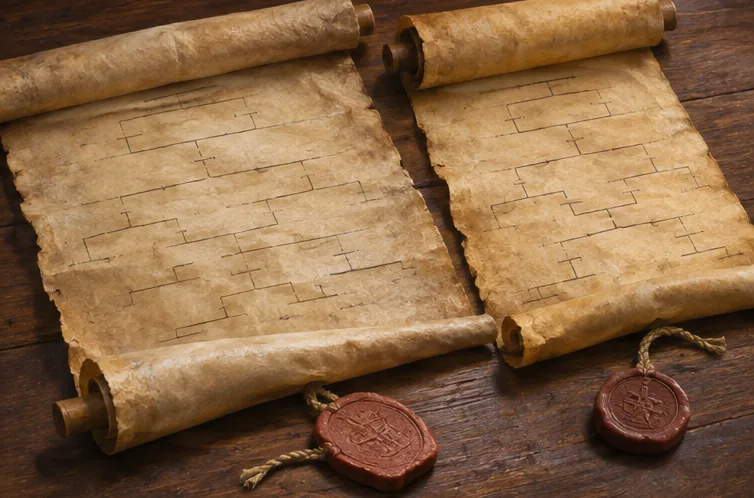
The Anglo-Saxon Chronicle also traces Hengist and Horsa’s genealogy to Woden in its annal for 449. Reading the accounts together reveals shared names and differences between editions. Sellar spells the brothers’ father Victgilsus; Giles gives Wihtgils. Record the edition used, then examine the texts’ transmission and source relationships. [3]
What the passage contributes
Bede preserves Woden as an ancestor of named leaders and links his stock with royal descent. The early manuscript history, parallel genealogies and scholarly studies give that testimony a documented setting. It is a substantial starting point for investigating how a founding figure was remembered across dynasties.
WodensMan develops the wider comparison through inscriptions, archaeological chronology and Scandinavian accounts of leadership and movement. Each witness contributes a distinct part of the historical record.
Read the sources and follow the investigation
Explore Woden in the Anglo-Saxon royal genealogies and the book The Historical Odin: Myth or Memory?. The bibliography below leads directly to the editions and publications used here.
Sources and further reading
- Bede, Ecclesiastical History of England, Book I, chapter 15, translated by A. M. Sellar (1907). Complete translation at Project Gutenberg.
- Cambridge University Library, MS Kk.5.16, the Moore Bede, manuscript catalogue, on Bede's completion date and early textual witness.
- Anglo-Saxon Chronicle, annal 449, J. A. Giles translation, page 25; Compare the genealogy under 449.
- Charlotte Behr, “The origins of kingship in early medieval Kent,” Early Medieval Europe 9, no. 1 (2000), 25–52, DOI: 10.1111/1468-0254.00058. Publisher abstract consulted.
- Craig R. Davis, “Cultural assimilation in the Anglo-Saxon royal genealogies,” Anglo-Saxon England 21 (1992), 23–36, DOI: 10.1017/S0263675100004166. Publisher extract consulted.
- Hermann Moisl, “Anglo-Saxon royal genealogies and Germanic oral tradition,” Journal of Medieval History 7, no. 3 (1981), 215–248, DOI: 10.1016/0304-4181(81)90002-6. Publisher abstract consulted.