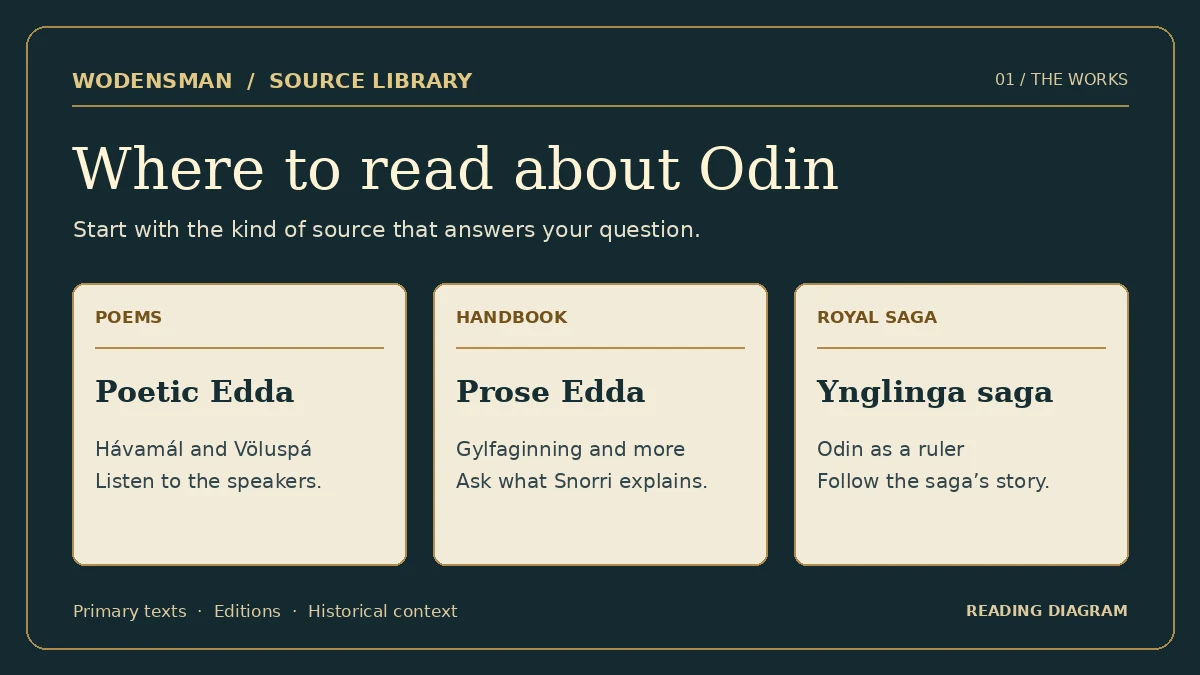
Start with the text that answers your question. The Poetic Edda collects anonymous Old Norse poems. Snorri Sturluson’s Prose Edda explains myths and poetic language. His Ynglinga saga, the opening saga of Heimskringla, puts Odin into a story about places, rulers and royal ancestry.
The same name can appear in all three, but the text may be doing something different each time. A poem can put words in Odin’s mouth; a handbook can use him to explain a name or a figure of speech; a saga can make him a ruler with a territory. Those are different kinds of evidence. The first thing to ask is which book you are actually reading.
| If you want to read about… | Start here | What you are reading |
|---|---|---|
| Odin hanging on the tree and taking up the runes | Hávamál, stanzas 139–140 in Bellows | A poem in the Poetic Edda |
| Odin’s place among the gods and his different names | Gylfaginning, chapter 20 in Brodeur | Part of Snorri’s Prose Edda |
| Ásaland, the Tanais, and Odin as a ruler who travels north | Ynglinga saga, chapters 1, 2 and 5 in Laing | The opening saga in Snorri’s Heimskringla |
The Poetic Edda: listen to the speaker
In Hávamál, the speaker tells how he hung for nine nights, wounded with a spear and offered to Odin, before taking up the runes. Read the two stanzas together. The first tells you who receives the offering; the second tells you what the speaker gains. That sequence matters more to understanding the poem than a modern summary that reduces the scene to ‘Odin invented the runes’. Henry Adams Bellows numbers these stanzas 139–140. Check the numbering if your translation gives a different reference. [1]
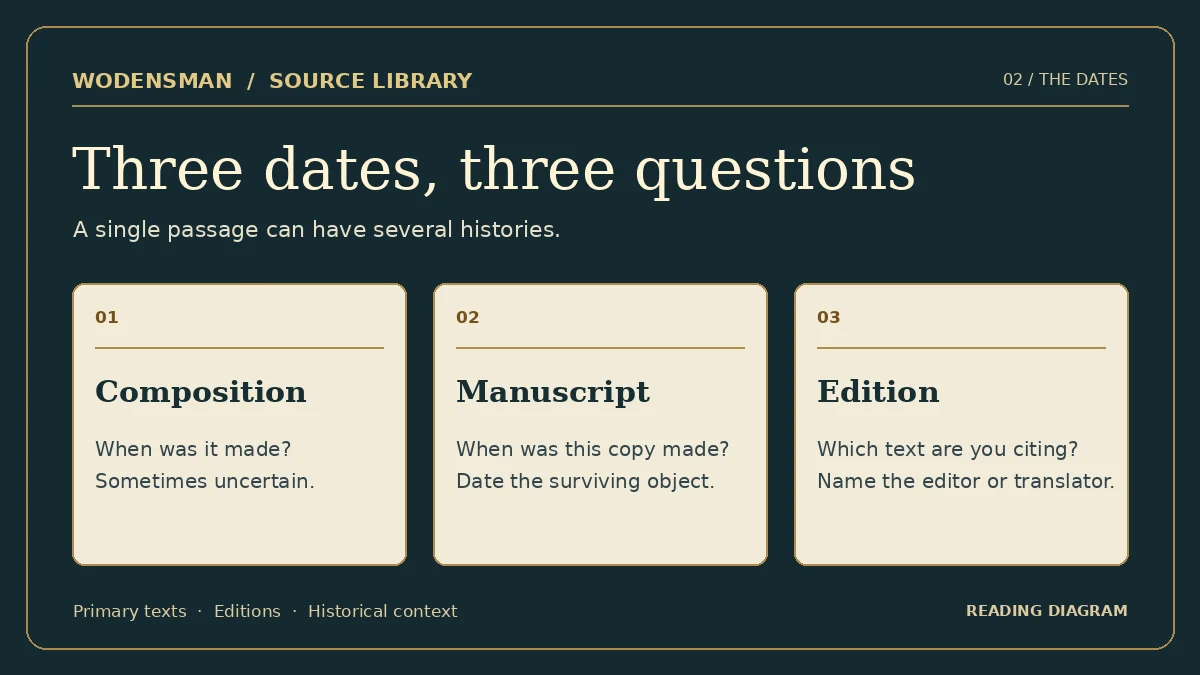
Bellows’s English translation appeared in 1923. One of the chief medieval witnesses, the Codex Regius (GKS 2365 4to), dates to around 1270. Neither date tells you when the lines were first composed or performed. If the wording matters to your argument, the Árni Magnússon Institute’s edition lets you compare a manuscript image with a transcription.
The Prose Edda: ask why Snorri tells the story
In Gylfaginning, Gylfi travels in disguise and asks questions. In chapter 20 he asks which of the Æsir is foremost and why Odin has so many names. The reply gives Odin a place among the gods and explains his names through different roles, languages and stories. Look at the question as well as the answer: the writer is organising material to explain a tradition. Snorri also quotes verse, which means a line in his book can have a different history from the prose around it. [2]
Arthur Gilchrist Brodeur’s 1916 volume is an easy way into the Prologue and Gylfaginning; it also includes Skáldskaparmál. It does not contain Háttatal, the metrical work normally printed as the third main part. If someone cites ‘the Edda’, identify the section before deciding whether you have the right passage.
Ynglinga saga: follow the story in chapters, not on a modern map
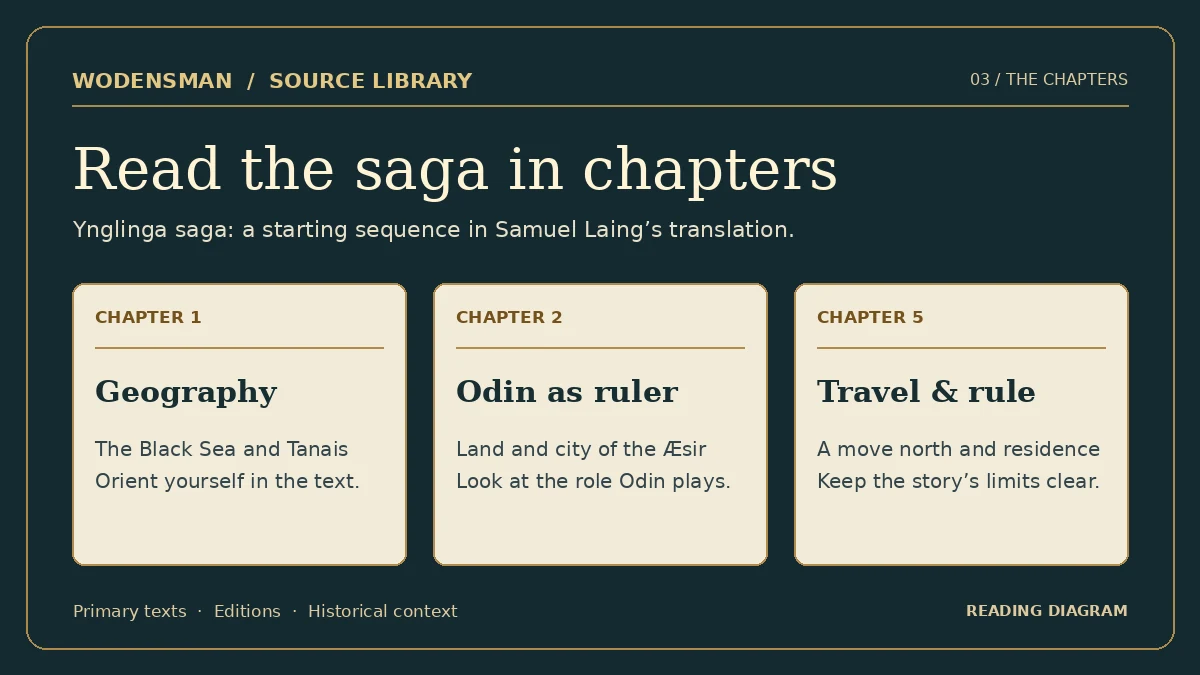
Laing’s chapter 1 sets out the geography around the Black Sea and the Tanais, usually identified with the Don. Chapter 2 introduces the land and city of the Æsir and presents Odin as their chief. Chapter 5 puts his move in the context of Roman expansion and eventually places his residence near Lake Mälaren. The steps belong to a narrative written in medieval Iceland, centuries after the world that WodensMan investigates. A named river is a useful clue to the writer’s geography. A historical migration would also need a route, dating and evidence independent of the saga.
Compare Laing’s edition [3] with Alison Finlay’s translation. Keep the saga’s political geography distinct from a modern reconstruction. For the underlying research question, see Where did Odin come from?
Three checks before you cite Odin
- Name the work and the unit. Write Hávamál 139–140, Gylfaginning 20, or Ynglinga saga 2. ‘The Edda’ alone leaves readers guessing.
- Name the translation. Editions may divide passages differently, and an English spelling such as Othin, Odin or Óðinn may reflect a translator’s convention.
- Say what the passage can show. A poem can tell you what its speaker says; a saga can tell you how its writer presents the past. An early inscription answers a different question. See the earliest evidence for Odin and Woden for that comparison.
This is the reading method behind The Historical Odin: Myth or Memory?. Start with the same editions to check the argument for yourself.
Sources and editions
- Anonymous, Hávamál 139–140, in The Poetic Edda, translated by Henry Adams Bellows (1923). Project Gutenberg edition.
- Snorri Sturluson, Gylfaginning 20, in The Prose Edda, translated by Arthur Gilchrist Brodeur (1916). Read the chapter; compare Anthony Faulkes’s Old Norse edition, second edition (2005).
- Snorri Sturluson, Ynglinga saga, chapters 1–2 and 5, in Heimskringla, translated by Samuel Laing (1844). Read Laing’s translation.