Research
4 Breakthroughs That Put Woden Back Into History
 By Christopher T. Knight
Published
Snorri Sturluson wrote centuries after the Migration Period. Anglo-Saxon kings claimed descent from gods. Stories of eastern homelands were classified as medieval prestige fiction. And without…
For generations, the historical traditions surrounding Woden and Odin were easy to dismiss.
Snorri Sturluson wrote centuries after the Migration Period. Anglo-Saxon kings claimed descent from gods. Stories of eastern homelands were classified as medieval prestige fiction. And without archaeology, inscriptions, or genetics capable of testing those traditions, the historical question could be pushed safely into the realm of mythology.
That situation has changed.
A fifth-century Danish gold bracteate has pushed the securely attested name Wodan back approximately 150 years. Early royal genealogies repeatedly place Woden astonishingly close to the Migration Period. Historical sources independently identify an eastern Eurasian people called the As with the Alans.
And archaeology in the North Caucasus has uncovered an unexpectedly sophisticated early Alan world flourishing immediately before the great migrations of Late Antiquity.
Then ancient DNA added something else: proof that Scandinavia was part of a much larger demographic system in motion.
The evidence is no longer coming from one medieval storyteller.
It is coming from runes, archaeology, genealogy, historical ethnography, linguistics, and genetics.
Our investigation works from a Layered Memory Model: myth, ancestry, political legitimacy, migration memory, and the deeds of historical rulers could accumulate around the same sacred figure over centuries.
The question is therefore simple:
Is there a recoverable historical layer beneath the Woden tradition?
Four discoveries have made that question much harder to dismiss.
1. Vindelev: “He Is Wodan’s Man”
Then Denmark gave us another shock.
In 2020, a spectacular Migration Period gold hoard was discovered near Vindelev.
Among the objects was a fifth-century gold bracteate carrying an inscription that completely changed the chronology of Wodan’s securely attested name.
Runologists deciphered the crucial phrase:
iz Wōd[a]nas weraz
Usually translated:
“He is Wodan’s man.”
The bracteate belongs to the early fifth century.
That pushed the earliest secure written occurrence of Wodan’s name backward by roughly 150 years.
But the date is only half of the story.
The object depicts a human figure.
And the inscription appears to identify that figure through his relationship with Wodan:
Wodan’s man.
For decades, figures on this class of bracteate were frequently interpreted as representations of Odin himself.
Vindelev complicated that picture dramatically.
The runologists who deciphered the text specifically raised the possibility that the human portrait instead represents a king, chieftain, or elite ruler associated with Wodan.
That matters because Migration Period political society revolved around personal bonds of loyalty.
Kings surrounded themselves with warrior retinues.
Chieftains distributed wealth.
Elite identity was advertised through gold, weapons, genealogy, religious authority, and allegiance.
Now place the phrase “Wodan’s man” inside that world.
Not carved centuries later.
Not preserved only in Icelandic poetry.
On Migration Period gold.
Beside a human elite figure.
And dated to the early fifth century.
One inscription gives us:
The other gives us:
WODAN’S MAN
Both belong to the early Germanic runic world.
Both appear far earlier than the Viking Age literary sources.
And suddenly Woden is exactly where the later genealogical traditions say we should start looking:
inside the Migration Period elite world of northern Europe.
2. The King-Lists Put Woden in the Same Centuries
The Anglo-Saxon royal genealogies produce one of the strangest chronological convergences in the entire investigation.
Multiple ruling houses traced themselves to Woden.
Kent.
Wessex.
Mercia.
East Anglia.
Northumbria.
Different kingdoms.
Different dynasties.
Different political histories.
Yet the same ancestral figure repeatedly appears near the root.
The Kentish pedigree gives us the cleanest test.
Bede preserves the lineage of Hengist through:
Woden → Vecta → Vitta → Victgils → Hengist
Hengist belongs to the traditional chronology of the Anglo-Saxon entry into Britain around 449 CE.
Count the generations.
Woden sits only four father-to-son transitions above him.
Using a normal historical generation length of roughly 20–30 years, that places Woden approximately 80–120 years before Hengist:
c. 329–369 CE
Right inside the Migration Period horizon.
Other royal pedigrees vary in length and transmission, but the overall phenomenon remains striking: Woden repeatedly sits surprisingly close to historically visible early medieval rulers.
This becomes even more interesting when the genealogies are placed beside the runic evidence.
The Kentish lineage points toward a Woden broadly in the fourth century.
Vindelev gives us Wodan in the early fifth century.
Then Hengist enters the historical tradition in the mid-fifth century.
That is a remarkably narrow chronological corridor.
The genealogies may have accumulated legendary material. They may have been edited. They may have served political purposes.
But their chronological gravity keeps pulling Woden toward the same period in which his name begins appearing in the physical archaeological record.
That is the convergence.
3. Snorri’s Eastern “As” Were a Real Historical People
Now we move east.

At the beginning of Ynglinga saga, Snorri Sturluson describes a region east of the great river he calls Tanakvísl, conventionally identified with the ancient Tanais—the Don.
There, he places:
Ásaland
or
Ásaheimr
Its chief city—the höfuðborg, literally the principal city or capital—was:
Ásgarðr
And its ruler was Odin.
For generations, this was easily explained as medieval wordplay.
Æsir.
Asia.
Asaland.
A learned Christian author transforming gods into ancient eastern rulers.
Then historical ethnography presents us with a problem.
Because an eastern people called the As actually existed.
And medieval authors explicitly identify them as the:
ALANS
William of Rubruck records the Alans as:
Alani sive Aas
“Alans, or Aas.”
John of Plano Carpini similarly gives:
Alani sive Assi
“Alans, or Assi.”
Other sources preserve related forms throughout Eurasia:
As
Ās
Assi
Yas
Jász
Os
Ovs
Asut
The As-name was not a nineteenth-century theory constructed to rescue Snorri.
It was a historical ethnonym.
And the people carrying it occupied exactly the broad eastern world that makes Snorri’s geography so intriguing.
The Alans were an Iranian-speaking military population associated with the Pontic-Caspian steppe, the northern Caucasus, the Don region, and the lands north of the Black Sea.
Then the fourth century changed everything.
The Huns crashed into the western steppe.
The Alan world fragmented.
Some groups remained in the Caucasus.
Others moved west.
Alan forces appear across Europe—Gaul, Spain, North Africa, Italy—and inside coalitions with Germanic populations.
Now compare the structures.
Snorri gives us:
As
an eastern homeland,
the Don frontier,
an organised ruling elite,
Odin,
and a westward migration.
History gives us:
As/Alans
the Pontic-Caucasian world,
the Don and Black Sea corridors,
powerful military elites,
and major westward migrations beginning in Late Antiquity.
That does not look like a random medieval name game anymore.
It looks like something worth investigating.
4. Zilgi: The World the “As” Actually Lived In
For a long time, another objection made any historical comparison with the Alans easy to dismiss.
They were supposed to have been primitive nomads.
Horse warriors.
Wagon dwellers.
A mobile steppe people incapable of producing the organised political centres described in later traditions.
Then archaeologists excavated Zilgi.
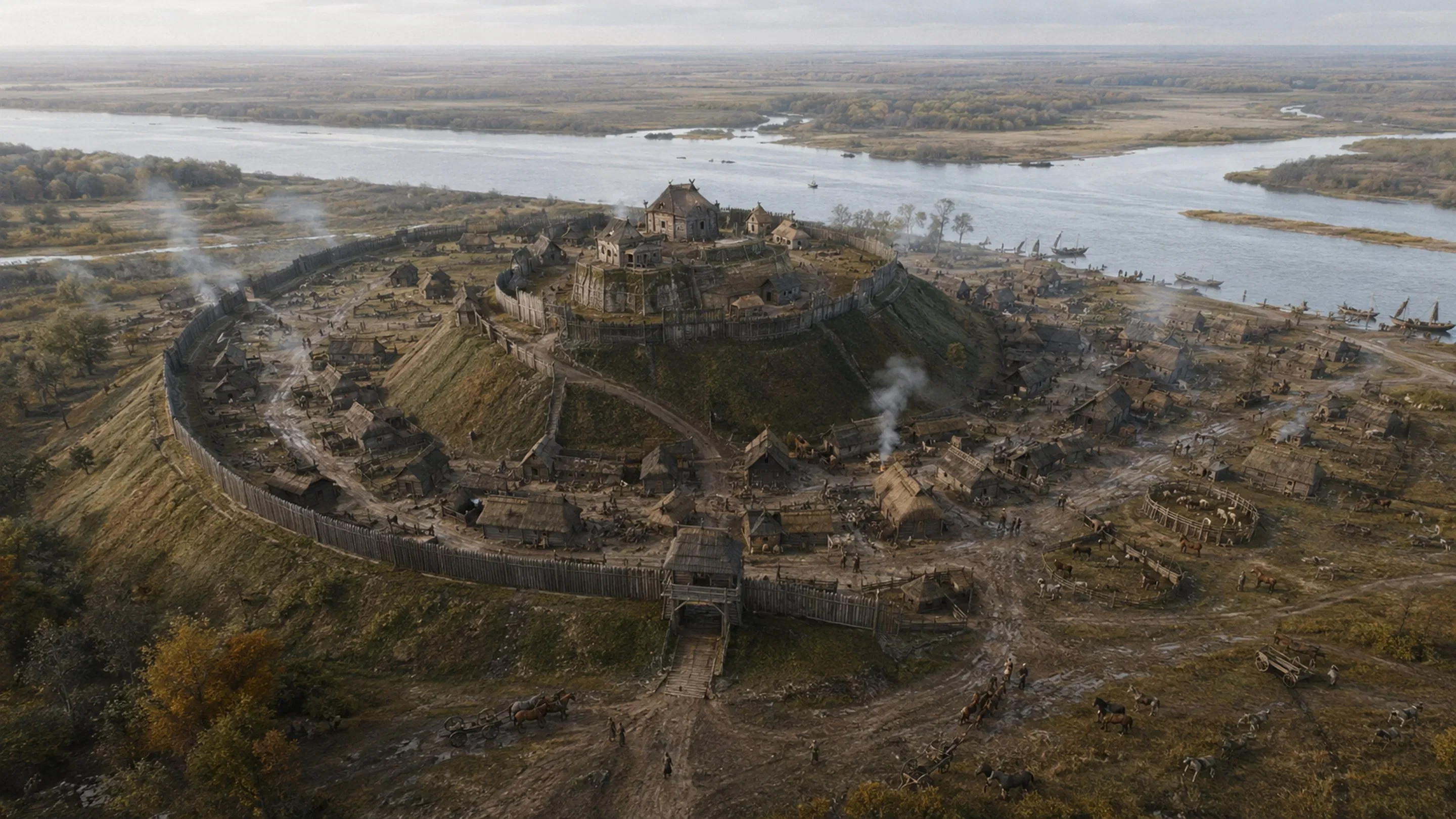
Located in modern North Ossetia, Zilgi has been described by its excavators as an:
early Alan proto-city
And its scale is extraordinary.
The settlement covered approximately 1.5 square kilometres.
It occupied seven hills.
At its centre stood a fortified citadel surrounded by densely occupied habitation zones.
The defensive works were enormous.
Some ditches reached at least:
6 metres deep
and
15 metres wide
Fortifications incorporated mud brick, wattle-and-daub construction, and river stone.
Archaeologists found stone-paved surfaces, dense residential occupation, grain-storage installations, craft production, metalworking, weaving, and large-scale ceramic manufacture.
More than 70,000 diagnostic ceramic fragments were recovered.
The settlement participated in trade networks connecting the Central Caucasus with the Bosporan world, Transcaucasia, the Lower Don, and the Eurasian steppe corridor.
Its economy supported specialised craftsmen.
Its fortifications required enormous coordinated labour.

Its density approached an urban level.
And the excavators concluded that the evidence may point toward an unexpectedly early form of proto-state organisation in Alania.
Then comes the date:
2nd–4th centuries CE
That matters enormously.
Because this sophisticated Alan-associated world was flourishing immediately before the great Migration Period upheavals.
And Snorri’s own political description of his eastern As is more interesting in this context than is usually recognised.
His As possess a höfuðborg—a chief city or capital.
Odin rules there.
It contains a major cult centre.
A group of twelve high-ranking religious-political figures administer sacrifice and judgment.
That is an organised political-religious centre.
Now archaeology shows us that the early Alan world really did contain large fortified centres, concentrated populations, specialised industries, major trade networks, and political structures capable of organising enormous communal projects.
Then the system breaks.
Zilgi’s excavators associated its decline with the collapse of the Late Sarmatian economic world on which these communities depended.
At almost the same historical moment, the Hunnic invasions shattered the western Alan world and launched populations across Europe.
The sequence is striking:
A sophisticated eastern political world flourishes.
The steppe system collapses.
The Huns arrive.
Alan populations fragment.
Military elites move west.
Centuries later, northern tradition remembers an eastern people called the As whose ruler moved west.
That is a historical pattern worth taking seriously.
The DNA Backdrop: Scandinavia Was Never a Sealed Box
Ancient DNA adds one final layer.
In 2025, Leo Speidel and an international team published a major Nature study using a new high-resolution genomic method called Twigstats to analyse 1,556 ancient European genomes.
The study revealed extraordinary mobility during the first millennium CE.
During its first half, Scandinavian-related ancestry spread outward into central, western, and eastern Europe.
Later, ancestry connected with continental European populations moved back into Scandinavia.
By around 800 CE, substantial central-European-related ancestry appears across parts of southern Scandinavia.
Researchers also identified an eastern Baltic signal concentrated particularly in southeastern Sweden and Gotland.
Strontium isotope evidence showed that some individuals carrying continental ancestry had actually grown up locally in Scandinavia.
The genetic transformation visible today occurred over centuries, and the largest central-European signal detected by Twigstats becomes prominent after our core 250–550 CE horizon.
But its historical implication is still devastatingly important:
Scandinavia was part of a demographic network.
People moved.
Families moved.
Warrior groups moved.
Ancestry moved.
Political upheaval on the continent could eventually reshape populations in the North.
The physical mechanism required by the migration traditions unquestionably existed.
Legend Meets the Evidence
Now put everything on the table.
A physically studied Elder Futhark inscription in the Mälaren region preserves:
VINDELEV
Early fifth-century Scandinavian gold preserves:
“HE IS WODAN’S MAN.”
THE KING-LISTS
Woden repeatedly appears only a limited number of generations above historically situated Migration Period dynasties.
THE AS
Medieval Eurasian sources explicitly record the Alans as:
AAS / ASSI / AS
ZILGI
Archaeology reveals a sophisticated, fortified Alan-associated proto-urban world flourishing during the:
2nd–4th centuries CE
ANCIENT DNA
Scandinavia emerges as part of a vast first-millennium system of population movement and changing ancestry.
These sources were never designed to agree with one another.
A runestone does not care what Snorri wrote.
A Danish bracteate does not care about an Anglo-Saxon pedigree.
An Alan proto-city in the Caucasus does not care about a Scandinavian genealogy.
A thirteenth-century traveller recording Alani sive Aas does not care about Ynglinga saga.
An ancient genome does not care about any of them.
Yet the same historical landscape keeps appearing.
Woden.
Migration.
The fourth and fifth centuries.
Elite warrior societies.
Eastern connections.
The As.
The Don and Caucasus world.
Population movement into northern Europe.
At some point, coincidence stops being an explanation.
It becomes the thing that needs explaining.
The historical Woden case is no longer built on asking people to believe Snorri.
It is built on asking why independent pieces of evidence—separated by discipline, geography, language, and centuries of transmission—keep converging on the same narrow historical horizon.
Somewhere beneath the god, the genealogies, the runes, and the migration legends lies a historical memory that northern Europe refused to forget.
And we are getting closer to it.
TO FOLLOW THE INVESTIGATION, VISIT WODENSMAN.COM
ABOUT THE AUTHOR
Christopher T. Knight
Independent researcher, creator of WodensMan and author of The Historical Odin: Myth or Memory?.