Research
Ancient DNA Has Not Found Odin. It May Be Looking at the Wrong People.
 By Christopher T. Knight
Published
There is no skeleton with his name carved into it. No genome has connected a man buried in Sweden directly to Azagarium, and no genetic study has completed a trail from the Dnieper to Lake Mälaren.
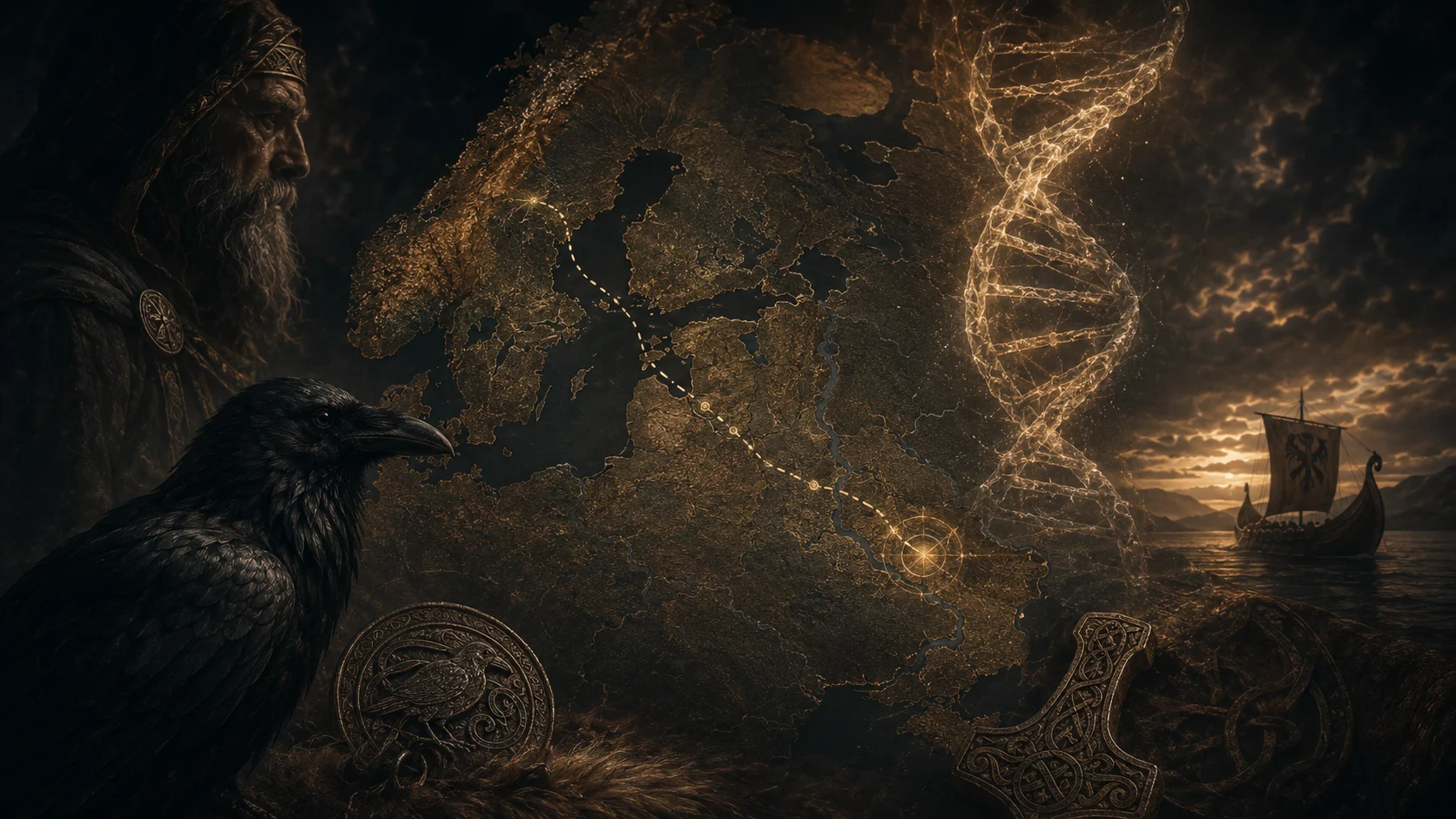
Ancient DNA has not found Odin.
There is no skeleton with his name carved into it. No genome has connected a man buried in Sweden directly to Azagarium, and no genetic study has completed a trail from the Dnieper to Lake Mälaren.
That needs to be said plainly.
But after going through the major Scandinavian DNA studies, I have become convinced that we have been asking genetics to find the wrong kind of event. People keep looking for evidence of a foreign population arriving in Scandinavia and replacing the people already there. That is not what the surviving tradition describes, and it is not what the historical model I am investigating requires.
The tradition points towards a ruling lineage.
That is a very different event, and it would leave a very different genetic footprint.
The theory does not require thousands of eastern migrants to overwhelm Scandinavia. It requires a much smaller coalition to enter the region, gain influence, marry into the existing population and eventually become almost impossible to distinguish from the people they ruled.
Once we test that version of the theory, the DNA evidence starts to look very different.
We Were Looking for the Wrong Ancestry
One of the first mistakes in this discussion was treating the proposed homeland as though it were somewhere in the Caucasus.
It was not.
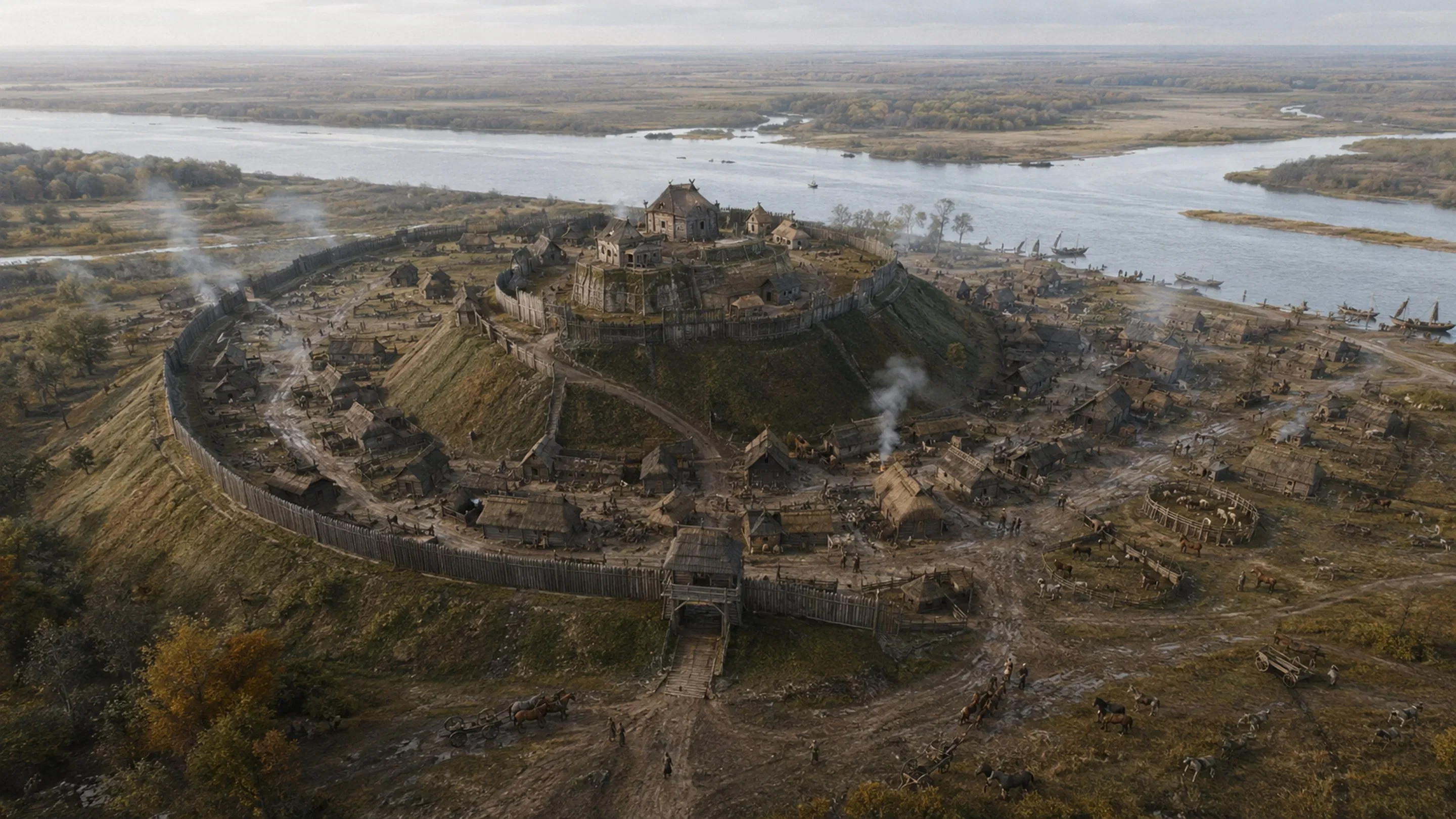
Ptolemy placed Azagarium among the settlements situated along the Borysthenes, the ancient Dnieper, inside his European Sarmatia. The working identification places it somewhere in the Middle Dnieper region of what is now Ukraine.
Azagarium was therefore eastern European. It belonged to the forest-steppe and the wider North Pontic world. It was not a city in Iran, Georgia or the Caucasus.
That correction matters because it changes what we should expect to find.
A population living around the Middle Dnieper would not necessarily appear genetically identical to modern Iranians or Caucasus populations. The region stood between several worlds. Sarmatians, Alans, Goths, eastern Europeans and steppe populations moved through the same broad frontier, fought over it, traded across it and mixed within it.
The genetic target was never simply “Caucasus DNA.”
The real question is whether ancestry connected with the eastern European, Baltic and continental corridor entered Scandinavia during or after the period in which the proposed migration could have taken place.
On that question, the evidence becomes far more interesting.
A Ruling Lineage Does Not Need to Replace a Population
Suppose several hundred newcomers entered a Scandinavian region occupied by tens of thousands of local people. Even if those newcomers gained military or political control, the population would still remain overwhelmingly Scandinavian.
A ruler does not need to replace a population in order to rule it.
History is filled with small dynasties, military elites and aristocratic families controlling populations far larger than themselves. They could transform royal traditions, political structures, military organisation and religious practice without producing an equally dramatic change in the general population’s DNA.
That distinction matters because the genealogies do not present Woden as the biological father of every person in Scandinavia. They place him at the head of ruling families.
That is a claim about dynasty and legitimacy. It is not a census report.
Even if an incoming ruling family did carry ancestry from farther east, that ancestry would decline rapidly through generations of marriage with local families. After ten generations, the expected autosomal contribution from one specific ancestor averages less than one-tenth of one per cent. After fifteen generations, it falls to roughly one part in 32,768.
Inheritance is also random. A person can genuinely descend from a historical ancestor while carrying no identifiable autosomal segment from that particular individual.
The dynasty could remember its founder long after its DNA barely did.
Lamnidis: The North Was Never Sealed Off
The 2018 study by Lamnidis and colleagues examined ancient individuals from Finland and northwestern Russia. The researchers found that Siberian-related ancestry had reached northern Europe at least 3,500 years ago.
They also found that this ancestry did not arrive in one single movement. It entered northern Europe through multiple episodes of migration and mixture.
That is not evidence for Odin’s migration. The dates are far too early, and the study does not concern the proposed destination around Mälaren.
What it does show is that northern Europe was never the isolated genetic world people sometimes imagine.
The study also examined Iron Age individuals from Levänluhta in Finland. Some were genetically closer to modern Saami populations than to modern Finns. That means Saami-related populations once lived considerably farther south than they do today.
Modern ethnic boundaries cannot simply be projected backwards onto the Iron Age. Populations moved. They merged with one another, disappeared from regions and were replaced by new identities.
Lamnidis does not give us Odin’s route. It establishes something more basic: people and ancestry had been moving into northern Europe from the east long before the Viking Age.
Margaryan: New People Entered Scandinavia Without Replacing It
The 2020 study Population Genomics of the Viking World analysed 442 ancient individuals. Its results showed gene flow entering Scandinavia from both the south and the east.
That sounds dramatic until the other half of the finding is considered.
Most Viking Age Scandinavian populations remained largely descended from earlier Iron Age populations. New ancestry entered Scandinavia without erasing the population already living there.
That is exactly the kind of pattern we would expect from smaller migrations, travelling groups and political elites.
The local population remained in place. Foreign ancestry appeared in more limited amounts. Newcomers entered Scandinavian communities and became part of them, while Scandinavian identity continued to include people of different biological backgrounds.
The study also found that a simple three-part ancestry model could not explain every Scandinavian and Baltic population. Some groups required additional modelling involving Caucasus hunter-gatherer-related or East Asian-related ancestry.
That cannot be treated as proof of a recent migration from the Caucasus. Caucasus hunter-gatherer ancestry is an ancient component that spread through many later Eurasian populations.
But the result still matters. Scandinavian genetic history was not simple, uniform or isolated.
Why Gotland Keeps Appearing
Gotland may be one of the most important locations in this entire discussion.
Several Viking Age individuals from the island showed strong genetic affinities with Baltic and eastern European populations. Many clustered with ancient people from across the Baltic.

That is biological evidence that people were crossing the sea, not only goods, weapons and stories.
Gotland also contained unusually varied ancestry. Its population reflected connections with several Scandinavian regions as well as communities farther east.
Most of these samples are later than the period in which I place the original migration. They cannot prove that a group travelled directly from Azagarium to Gotland.
But they demonstrate that the eastern Baltic was a genuine human corridor.
The proposed migration was never a direct leap from Ukraine to Sweden. A group moving north from the Middle Dnieper would have entered a larger movement zone involving the Baltic coast, Poland, Lithuania, the islands and the Scandinavian mainland.
Gotland sits directly inside that world.
Twigstats Found Eastern European Ancestry Along the Route
The 2025 Speidel study used Twigstats, a method designed to identify more recent ancestry relationships that older genetic methods often blurred together.
The study found that Early Iron Age individuals from the Scandinavian Peninsula were broadly similar to one another. After around 500 CE, however, central-European-related ancestry became established in Denmark and southern Sweden. By the Viking Age, it had spread across parts of southern Scandinavia.
The researchers did not find the same pattern in eastern-central Sweden, the area associated with the Svear and the Mälaren power centre.
That limitation matters. Twigstats did not discover Odin’s migration, and it did not identify a foreign ruling group in Mälaren.
But that was not the study’s only relevant result.
Twigstats also detected eastern European or eastern Baltic ancestry around Gotland. The closest available ancient comparisons came from Roman Iron Age populations in Lithuania and Poland.
Lithuania and Poland are not Azagarium. Azagarium was located farther south along the Dnieper.
They do, however, stand farther north along the same broad eastern European corridor.
Twigstats did not identify the people of Azagarium by name. It identified eastern European ancestry within the movement zone that a group travelling north from the Middle Dnieper could have entered.
The ancestry found on Gotland may have come directly from Lithuania or Poland. It may represent people absorbed during a longer migration. It may also reflect the closest available comparison because the correct Middle Dnieper populations have not yet been sampled adequately.
The study cannot decide between those possibilities.
What it does establish is that ancestry from eastern Europe crossed the Baltic and entered the Scandinavian world.
Migrants Do Not Remain Genetically Frozen
There is another problem with expecting the people who reached Scandinavia to look genetically identical to the people who left the Middle Dnieper.
A migration like this would not have been a bus ride.
It could have lasted years. It may have continued across more than one generation. People would have died along the way. Others would have remained behind. New warriors and allied families could have joined the group. Marriages would have taken place in different regions, and children would have been born while the coalition was still moving.
A group that began near the Dnieper could have reached the Baltic carrying ancestry from Poland, Lithuania, the Don region, Saxland or any number of places encountered along the route.
Its biological composition could change without its political identity changing.
The coalition could still preserve the name of its founder. It could remember an eastern homeland. It could continue to think of itself as one people while becoming increasingly mixed.
The people who reached Scandinavia did not have to be genetically identical to the people who began the journey.
That does not turn the Twigstats findings into proof. It explains why eastern Baltic and central European ancestry may be more relevant to the final stages of the migration than a clean Iranian or Caucasus signal.
We May Be Testing the People They Ruled
The largest problem may be the burial record itself.
Ynglinga saga associates Odin with a law requiring the dead to be burned with their possessions. The same tradition says Odin himself was cremated.
I am not treating that as independent proof that one historical man introduced cremation into Scandinavia. It is a late literary tradition, and it has to be handled as one.
But the remembered Odin order is still tied directly to cremation.
That creates a serious problem for ancient DNA.
Extreme heat destroys and degrades genetic material. DNA can sometimes survive partial burning, but recovery becomes much more difficult as thermal damage increases. One comparative study found no measurable authentic human DNA in petrous bones taken from ancient cremated individuals.
If an incoming ruler, his immediate family and his closest followers cremated their dead, then the people we most want to test may be the least likely to survive in the genetic record.
The recoverable DNA would come disproportionately from people who practised inhumation, from later mixed descendants and from the much larger local population.
We may be searching for the rulers inside the genomes of the people they ruled.
That does not turn missing DNA into evidence. Cremation cannot prove that an eastern dynasty existed.
It means that the absence of a large foreign population signal cannot decisively test a small ruling group whose remains may no longer preserve recoverable DNA.
The Oseberg Woman Changes the Discussion
This brings us to the younger woman buried in the Oseberg ship.
Researchers obtained a mitochondrial DNA profile from one of her teeth and assigned it to haplogroup U7. Per Holck noted that U7 was uncommon among the modern European populations used for comparison at the time and substantially more common among Iranians. He suggested that her maternal ancestors may have come from somewhere around the Black Sea.
The older woman’s remains were too contaminated to produce a reliable result.
This does not mean the younger woman was Persian. It does not mean her parents or grandparents had recently arrived from Iran.
Mitochondrial DNA traces only one direct maternal line: her mother, her mother’s mother, her maternal great-grandmother and so on. It tells us nothing about most of her ancestors.
Later research placed the deeper origin of U7 in the Near East around 16,000 to 19,000 years ago and identified ancient movements towards Europe and South Asia. Some branches of U7 had already entered Mediterranean Europe during the Neolithic, thousands of years before the Migration Period.

The published Oseberg result was not detailed enough to identify a younger subbranch or establish when that particular maternal line entered Scandinavia.
We cannot call her Persian. We cannot identify her as a descendant of Odin, and we cannot use her haplogroup to prove a Migration Period arrival from Azagarium.
But dismissing her as irrelevant would be just as careless.
Oseberg was not an ordinary burial. It was an extraordinary ship grave requiring enormous wealth, labour and political power. The burial contained animals, vehicles, textiles, carved objects and an intact chamber beneath a mound.
Whether either woman was literally a queen remains unresolved, but both belonged to an unmistakably elite funerary setting.
An uncommon maternal lineage with deep eastern and Near Eastern associations was therefore present inside one of Scandinavia’s highest-status burials.
There is no mass Iranian population surrounding her. There is one unusual maternal line embedded within Scandinavian elite society.
That resembles the genetic footprint predicted by a ruling-lineage model far more closely than a population-replacement model.
And we possess her DNA because she was buried intact rather than cremated.
Genealogy and DNA Remember Different Things
The royal genealogies preserve a name: Woden.
They place him at the head of ruling houses. They do not claim that later kings remained biologically unmixed, and they do not describe Scandinavia as becoming a foreign population.
Genealogy records descent, succession and legitimacy. It deliberately follows certain lines through a family tree while ignoring thousands of other ancestors.
DNA does not work that way.
A king could genuinely descend from a founder and still inherit no identifiable autosomal DNA from that individual after enough generations. The royal house could remain Woden’s dynasty through succession, identity and political memory even while becoming overwhelmingly Scandinavian genetically.
The genealogy may preserve the founder more clearly than the genome.
That is not a loophole invented to protect the theory. It is the basic difference between genealogical descent and detectable genetic inheritance.
What the Evidence Actually Adds Up To
None of these studies proves the historical Odin theory.
That is not what I am claiming.
Lamnidis shows that ancestry repeatedly entered northern Europe from the east and that ancient northern populations did not follow modern ethnic boundaries.
Margaryan shows that ancestry entered Scandinavia from the south and east while most of the population remained rooted in its Iron Age past.
The Gotland samples show that the Baltic was a corridor for human movement, not merely trade.
Speidel and Twigstats identify eastern European ancestry related to ancient populations in Lithuania and Poland reaching Gotland. They also show continental ancestry becoming established in southern Scandinavia after approximately 500 CE.
Azagarium was farther south along the Dnieper. Twigstats did not identify its population, but it found ancestry farther north inside the same broad movement corridor.
Cremation offers a serious reason why the earliest members of a ruling group might be missing from the DNA record.
Oseberg demonstrates that an unusual eastern-associated maternal lineage could exist inside an elite Scandinavian setting without any mass eastern population appearing around it.
The genealogies preserve exactly the kind of dynastic memory that could survive centuries of intermarriage after most distinguishable ancestry from a particular founder had disappeared.
This is not a completed genetic route.
It is a coherent historical model that fits the kind of evidence we currently have.
What We Still Need
The decisive evidence will require genomes from the correct places and centuries.
We need more individuals from the Middle Dnieper and Don regions dating between roughly 250 and 500 CE. We need comparable samples from Poland, Lithuania, Saaremaa and other possible Baltic staging points.
Most importantly, we need more fifth- to seventh-century individuals from the Mälaren region, particularly burials associated with the emerging elite.
Even then, cremation may prevent us from testing the people most directly connected with the tradition.
The eastern ancestry already found in Scandinavia may belong to unrelated migrations. The Oseberg woman’s maternal lineage may have entered Europe thousands of years before she lived. The continental ancestry found by Twigstats may have nothing to do with the proposed movement.
All of those possibilities remain open.
Following the evidence does not mean forcing every study to support the theory. It means recognising where the evidence fits, where it does not and what discoveries would allow us to choose between competing explanations.
The Verdict
Ancient DNA has not found Odin.
It has not uncovered a foreign population that arrived and replaced Scandinavia. But the theory never required one.
The model involves a smaller coalition originating somewhere in the eastern European world. It moves through the Baltic and continental corridor, changes as it travels, gains power over a much larger local population and gradually disappears into that population through marriage.
That is exactly the kind of event population genetics would struggle to isolate centuries later, especially if the ruling group cremated its dead.
The studies reveal eastern movement into northern Europe, Baltic ancestry entering Gotland, gene flow reaching Scandinavia from the south and east, and major changes beginning around 500 CE. Oseberg adds an unusual eastern-associated maternal lineage inside one of Scandinavia’s most elite burial environments.
None of this proves the journey.
But it reveals a mobile, mixed and changing world in which such a journey could have happened. More importantly, it tells us what evidence we should be searching for next.
The DNA may preserve the road more clearly than it preserves the people who travelled it.
ABOUT THE AUTHOR
Christopher T. Knight
Independent researcher, creator of WodensMan and author of The Historical Odin: Myth or Memory?.