Research
As, Alans, and Æsir
 By Christopher T. Knight
Published
I know how this sounds before anyone says it. The Norse gods and the Alans. Odin and some Iranian speaking horse people from the steppe. The Æsir maybe being connected to the As or Alans. It…
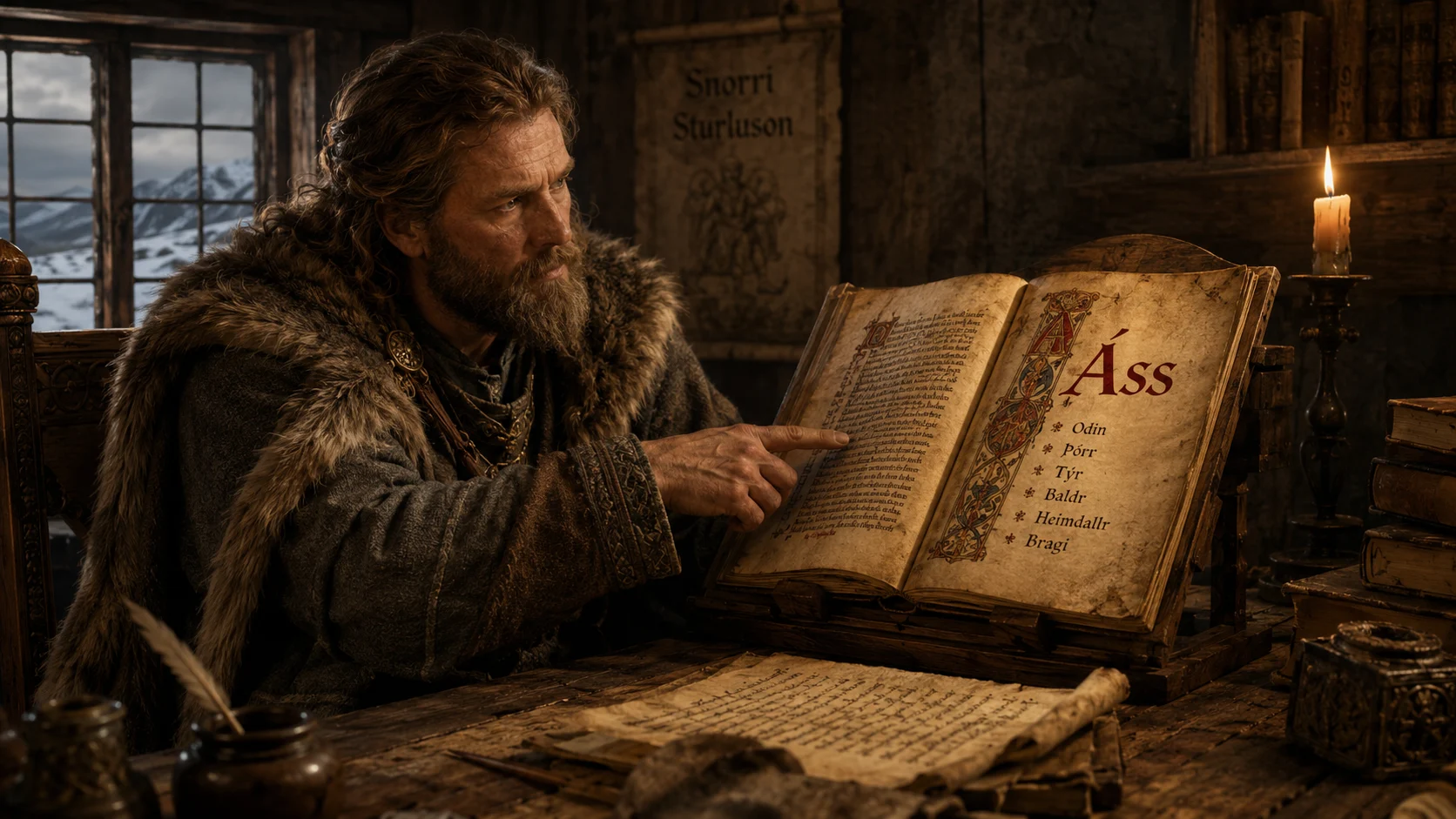
I know how this sounds before anyone says it. The Norse gods and the Alans. Odin and some Iranian speaking horse people from the steppe. The Æsir maybe being connected to the As or Alans. It sounds like the kind of thing you would see on some bad history page at three in the morning, right next to Atlantis, giants, and somebody claiming every ancient culture was secretly the same civilization.
That is why I did not want to like this theory at first. I really didn’t. It would be a lot easier to just say Odin is mythology, Snorri was doing medieval Christian storytelling, and the whole eastern origin story is just one more example of a writer trying to make pagan gods sound like ancient kings. That is the safe answer. Nobody gets in trouble for saying that. Nobody gets laughed at for repeating it.
The problem is that the details keep getting in the way.
Snorri does not simply say Odin came from somewhere mysterious. He gives Odin and his people an eastern origin. He talks about Asia, Asaland, Asaheim, and the Tanais. The Tanais is the Don River. That puts the story in the world north of the Black Sea, around the Don, the Azov, the Caucasus, and the steppe frontier. That is not some random fantasy direction. That is a real historical zone, and once you start looking at who was actually there, the Alans are sitting right in the middle of the problem.
The Alans were not a tiny footnote. They were one of the major warrior peoples of Late Antiquity. Roman writers knew them. Byzantine writers knew them. Armenian and Georgian writers knew them. Persian sources knew them. They show up around the Caucasus, the Don, the Caspian approaches, the Black Sea, the western migrations, and later medieval memory.
They were famous as mounted warriors, and they were part of the same violent world that involved Goths, Huns, Vandals, Sarmatians, Roman pressure, and collapsing frontiers.
Now add the name problem. Odin’s people are the Æsir. Snorri places them in Asaland. In and around the Alan world, we keep running into names like As, Asi, Ass, Asud, Jasi, Ossi, and related forms. I am not saying every one of those names means the exact same thing in every source. That would be sloppy. Names shift, writers misunderstand people, languages bend things, and medieval authors were not modern linguists.
But when the Norse tradition gives us the As in the east, and the historical east gives us As and Alan identities in the same general corridor, I do not think it is responsible to just shrug and move on.
A name alone would be weak. I have said that many times. If all we had was Æsir kind of sounding like As, I would not build anything on it. The reason this matters is because the name is sitting beside the geography. The geography is sitting beside a migration story. The migration story is sitting beside the same frontier where the Alans actually lived and moved. That is what makes the theory hard to throw away.
People act like Snorri being wrong about one thing means he is useless for everything. I do not buy that. Old traditions are messy. They compress time. They move things around. They turn people into symbols and symbols into people. They blend history with myth because that is how human memory works when it gets carried for centuries. A tradition can get the date wrong and still remember the direction. It can turn a war leader into a god and still preserve the old homeland.
It can confuse several movements into one story and still carry a real historical core.

That is where I think the Odin story may belong. I am not picturing a clean migration where one pure Alan tribe marches straight from the Caucasus to Sweden and becomes the Norse gods. That kind of thing is too simple, and history is almost never that clean. The world we are dealing with was made of coalitions. Alans fought with Goths. Some Alans joined the Huns. Some moved west with the Vandals. Some stayed in the Caucasus. Some appear under different names in different sources.
Some disappear into larger political formations. That is exactly how the steppe and frontier worlds worked.
This is important because a tradition does not need a whole nation to move untouched from one place to another. It needs people. It needs a ruling family, a warband, a priestly line, a group of horsemen, a marriage alliance, a court, a hostage, a singer, a story, a name that survives after the language changes. That is how memory moves. It does not travel in a straight clean line. It gets carried by mixed people in ugly historical situations.
The Gothic and Alanic world gives us a bridge. The Alans and East Germanic peoples were not living on separate planets. They were in the same Black Sea world, fighting in the same wars, reacting to the same Hunnic pressure, and sometimes serving in the same military formations. At Adrianople in 378, Gothic cavalry returned to the battlefield with an Alan detachment and helped destroy a Roman army. Archaeology also points to military exchange between Alan and Gothic environments.
Weapons, horse gear, tactics, and burial customs do not move around by themselves. People move them.
That matters for Odin because by the time we meet him in the Norse sources, he is absolutely part of the Germanic world. I am not trying to take him out of that world. I am asking whether the Germanic Odin tradition may have absorbed older eastern material before it reached the form we know. If Alans and Germanic peoples were already mixing in the Black Sea and Migration Period world, then an As or Alan memory entering Germanic tradition is not some wild fantasy.
It is exactly the kind of thing that could happen in that environment.
Then the Huns arrive and the whole frontier starts breaking apart. That is another piece people underestimate. The Hunnic expansion did not just move one people west. It shattered a whole system. Goths, Alans, Sarmatians, Bosporan populations, Caucasian groups, and other frontier communities had to adapt fast. Some submitted. Some fled. Some joined the Huns. Some joined other coalitions. Some moved west. Some were absorbed.
Some probably carried old names into new worlds where those names took on new meanings.
That is the kind of world where founder stories are born. A displaced leader gathers survivors. A ruling group moves through several territories. A mixed people later remembers itself as one people because that is simpler than the truth. A name gets preserved because it mattered to identity. A homeland gets remembered because leaving it was traumatic. A war leader becomes an ancestor, then a hero, then eventually something more than human.
This is why I keep coming back to Snorri. He may be late. He may be Christian. He may be wrong on chronology. But his story points east. It points toward the Tanais. It gives us the As. It places Odin’s people in the same broad direction where an As and Alan problem already exists. That does not mean he understood what he had. In fact, I doubt he fully did. He may have inherited a broken tradition and tried to make sense of it using the tools available to him.

The easy dismissal is that Snorri made it all up because medieval writers liked connecting things to Asia and Troy. Fine, that may explain part of the literary clothing around the story. But it does not explain why this particular cluster works as well as it does. It does not explain why the old name, the eastern direction, the Don region, the migration idea, and the Alan world all keep ending up on the same evidence board.
Maybe it is coincidence. I am not pretending coincidence is impossible. But I am also not going to pretend it is automatically the smartest answer every time the evidence gets uncomfortable. At some point, if every piece that was supposed to be nonsense starts pointing toward the same historical environment, then the “just coincidence” answer starts feeling less like caution and more like avoidance.
Where I land right now is pretty simple. I do not think the Æsir were the Alans in a clean one to one way. I think that is too blunt. I think the better possibility is that the Æsir tradition preserves memory of an As or Alan connected people, or ruling group, or coalition that entered the Germanic world during the chaos of the Migration Period. Over time that memory was reshaped, mythologized, and folded into the Odin tradition.
By the time Snorri writes it down, the original history is buried under layers of myth, genealogy, Christian explanation, and medieval geography.
But buried does not mean gone.
That is the whole point of this investigation. Myth does not always invent from nothing. Sometimes myth remembers badly. Sometimes it remembers sideways. Sometimes it preserves names and places long after the actual events have been distorted beyond recognition. I think Odin’s eastern origin story may be one of those cases.
So were the Æsir the Alans? I would not say it that simply. But were the Æsir tradition and the Odin migration story shaped by memory from the As and Alan world? I think that is very possible, and I think it explains more than the standard dismissal does.
The old sources say Odin came from the east. Maybe they were wrong. Maybe they were confused. Maybe they were preserving something older than they understood.
That is what I am trying to find out.
@wodensman
Christopher T. Knight’s forthcoming book, The Historical Odin: Myth or Memory?, continues the investigation.
ABOUT THE AUTHOR
Christopher T. Knight
Independent researcher, creator of WodensMan and author of The Historical Odin: Myth or Memory?.