Research
The Real Warrior King Behind Odin
 By Christopher T. Knight
Published
What if Odin was not simply invented as a god, but became the mythologised memory of a real eastern ruler, warrior elite, or founding migration?
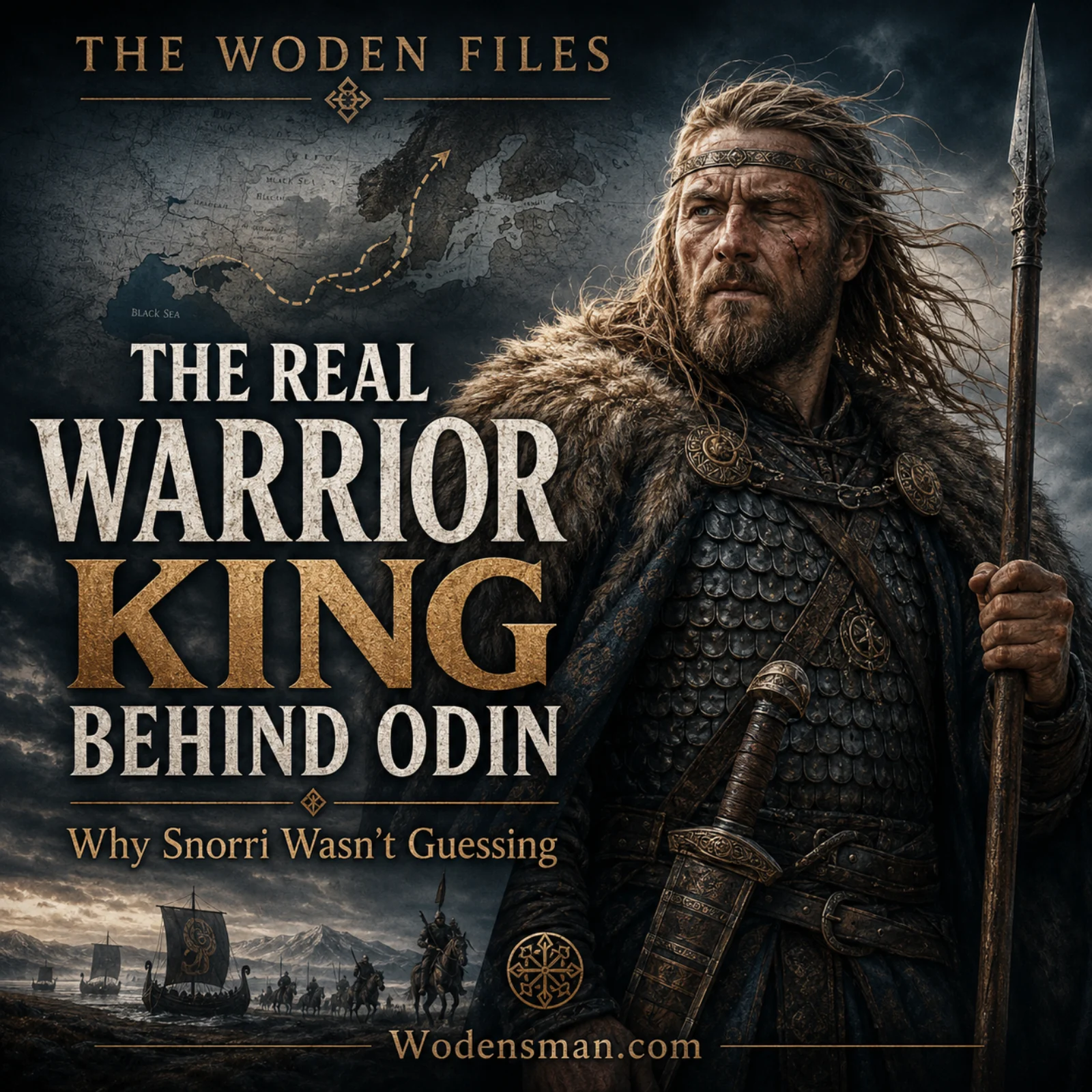
Why Snorri Wasn’t Guessing
ARTICLE SUMMARY
What if Odin was not simply invented as a god, but became the mythologised memory of a real eastern ruler, warrior elite, or founding migration?
In this article, we reopen Snorri Sturluson’s controversial claim that Odin and the Æsir migrated into the Germanic world from the east. For generations, that account has been dismissed as Christian reinterpretation, medieval fantasy, or an attempt to connect Scandinavian rulers to the prestige of Troy.
But that explanation leaves a serious problem: Snorri’s narrative contains a cluster of geographical, political, military, and historical correspondences that become increasingly difficult to dismiss as coincidence.
The investigation begins with Snorri himself—his education, political career, access to elite intellectual networks, and reliance on older historians, genealogies, skaldic poetry, translated Roman material, and inherited oral tradition. It then examines why the Trojan framework may have been a medieval method of organising and validating an older migration story rather than the source of that story.
Once the supernatural elements are removed, the narrative begins to resemble the history of the Pontic-Caspian frontier: a mounted warrior society living in the region Snorri describes, organised through confederation and elite leadership, displaced westward during the upheavals associated with the Hunnic invasions, and absorbed into Germanic political structures through alliance, service, and intermarriage.
The central question is no longer whether every detail in Snorri is literal. It is whether he preserved a genuine historical memory—compressed across centuries, attached to a founder figure, and transformed into mythology.
IN THIS ARTICLE
• Why Snorri’s eastern migration narrative was dismissed
• What Snorri’s education and political position gave him access to
• How genealogy and skaldic poetry preserved ancestral memory
• Why the migration tradition appears to predate Snorri
• Why Troy may be a framing device rather than Odin’s actual homeland
• How medieval Icelanders accessed Roman history and eastern geography

• Why the Alans fit the geography and social structure of the narrative
• How the Hunnic invasions provide a plausible historical migration trigger
• How multi-ethnic confederations become simplified into one founder
• Why the accumulated correspondences create a serious coincidence problem
• What mythology can preserve after ordinary historical records disappear
KEY NAMES AND SUBJECTS
Snorri Sturluson
The Prose Edda
Heimskringla
Skaldic poetry
Medieval genealogy
The Trojan origin tradition
Dares the Phrygian tradition
Roman historical literature
The Pontic-Caspian steppe

The Alans
The Hunnic invasions
Elite migration
Oral-history compression
The historical Odin hypothesis
FOLLOW THE INVESTIGATION
If you’d like to know how it all connects, grab Christopher T. Knight’s book The Historical Odin: Myth or Memory?, out December 1st.
Follow the evidence.
SOCIAL
Website: Wodensman.com
Social: @wodensman
YouTube and TikTok: @iamwodensman
SUGGESTED HASHTAGS
TheWodenFiles #HistoricalOdin #OdinResearch #NorseHistory #SnorriSturluson #NorseMythology #AncientHistory #Alans #MigrationPeriod #FollowTheEvidence
ABOUT THE AUTHOR
Christopher T. Knight
Independent researcher, creator of WodensMan and author of The Historical Odin: Myth or Memory?.