Research
Which Troy Did Odin Mean?
 By Christopher T. Knight
Published
The Trojan War is typically dated to the closing period of the Bronze Age (unless you ask Caleb Howells, which you most certainly should!). It would be impossible for a king who fled the fall of…
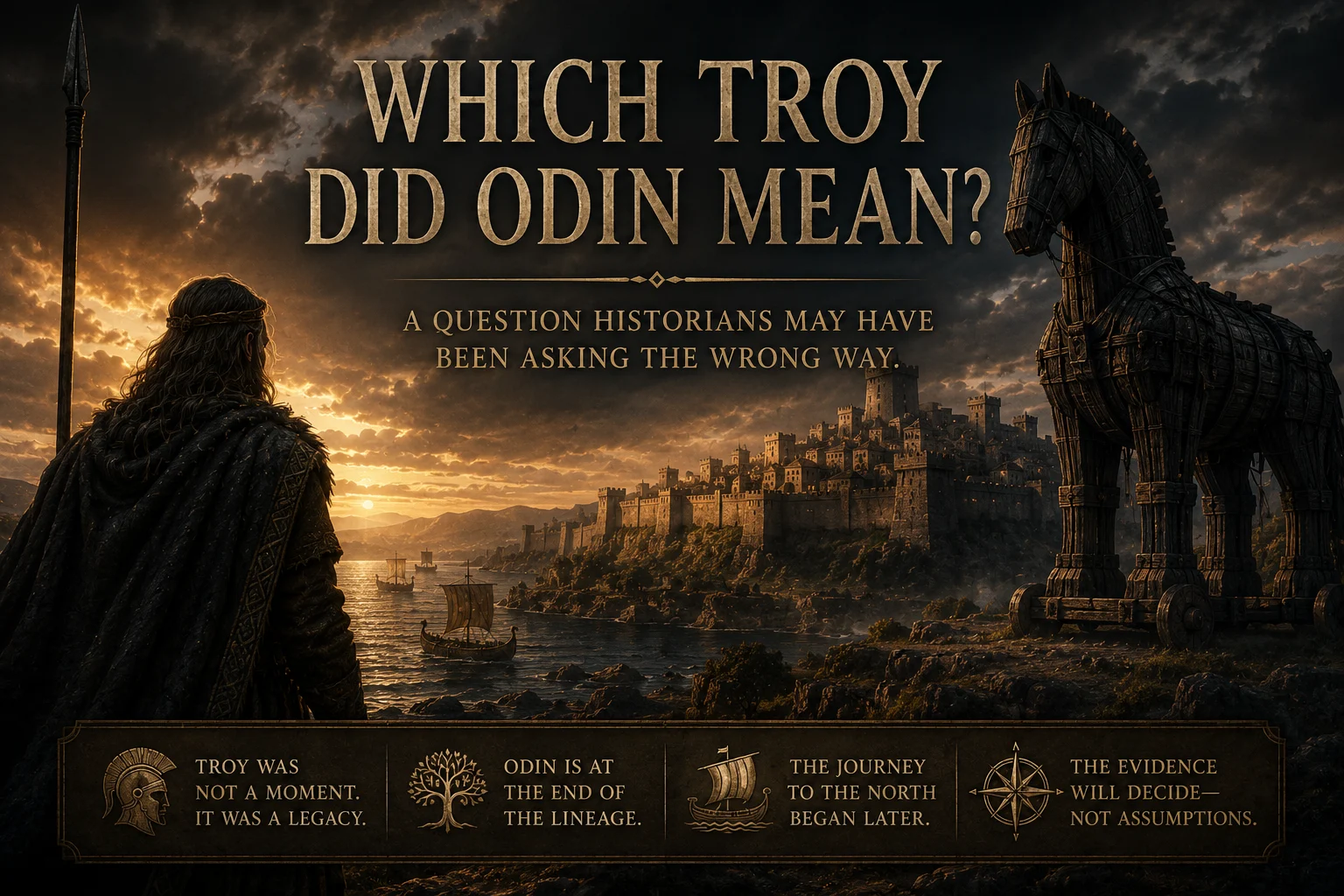
For generations, the Trojan element of Odin’s migration story has been reduced to a single sentence:
Snorri claimed that Odin escaped from Troy after the Trojan War.
Once the story is phrased that way, it sounds ridiculous.
The Trojan War is typically dated to the closing period of the Bronze Age (unless you ask Caleb Howells, which you most certainly should!). It would be impossible for a king who fled the fall of Priam’s city to show up hundreds or even over a thousand years later amid the timelines usually linked to migration legends in northern Europe.
The conclusion appears obvious:
Snorri’s account is impossible. The Trojan story was a medieval invention. There is nothing more to investigate.
But there is a problem.
That is not what the genealogy actually says.
The Prose Edda does not place the migrating Odin beside Priam at the beginning of the Trojan story. It places Odin at the far end of a long succession of descendants.
That distinction may change the entire question.
Odin Is Not at the Beginning of the Genealogy
The Prose Edda Prologue traces the line from the royal house of Troy through Tróán and Trór—identified with Thor—and then through numerous generations before arriving at Vóden, “whom we call Odin.”
The sequence is approximately:
Priam → Tróán → Thor/Trór → Lóridi → Einridi → Vingener → Vingethor → Magi → Móda → Seskef → Bedvig → Heremód → Ítermann → Athra → Ját → Skjaldun → Bjáf → Gudólfr → Finn → Fríallaf → Odin/Vóden
The genealogy itself is plainly composite and contains material connected with Anglo-Saxon royal pedigrees. It should not be treated as a precise biological record or converted mechanically into a dependable calendar. (Wikipedia)
But its historical accuracy is not the immediate issue.
The issue is what the genealogy was designed to communicate.
If the writer intended to say that Odin personally lived in Priam’s Troy during the famous war, there would be no reason to place a succession of fathers and sons between Priam and Odin.
Odin could simply have been described as a Trojan prince, commander or refugee.
Instead, Odin appears as the latest inheritor of a much older line.
The genealogy may be distorted. It may contain invented figures, missing generations, borrowed ancestors or deliberate political construction.
But even a constructed genealogy communicates sequence.
It says:
Odin descended from the Trojan royal line.
It does not plainly say:
Odin personally escaped from Troy when Priam’s city was destroyed.
Those are not the same claim.
Three Separate Claims Have Been Collapsed into One
Modern retellings frequently merge three different propositions.
Trojan ancestry
Odin belonged to, or claimed descent from, a Trojan royal or ancestral line.
Personal residence
Odin himself was born in, lived in or ruled a place called Troy.
Trojan War chronology
Odin lived during Priam’s reign and was personally present during the Trojan War.
The first claim does not automatically establish the second.
The second does not automatically establish the third.
A medieval king could claim descent from Rome without having lived in the Roman Republic. A later dynasty could identify itself as Persian without its current ruler having lived under Cyrus the Great. A population could preserve the identity of an ancestral homeland centuries after leaving it.
Why, then, has Odin’s claimed Trojan descent been treated as proof that Odin personally walked out of the burning Bronze Age city?
That appears to be an interpretation imposed upon the genealogy—not something the genealogy clearly states.
The Migration Begins After the Genealogy
After completing Odin’s ancestry, the Prologue introduces Vóden as a man renowned for wisdom and accomplishments. It then describes him preparing to leave Turkland with a great company of people.
Odin and his followers travel into Saxland and eventually farther north. He establishes rulers, dynasties and settlements. The narrative presents Trojan custom and government as something carried forward into the new northern world. (Wikipedia)
That creates a very different narrative structure:
Troy → ancestral dynasty → successive generations → Odin → migration north
The popular version reduces it to:
Troy falls → Odin escapes → Odin travels north
The first is a dynastic inheritance story.
The second is a refugee story.
The sources may contain elements of both, but they should not be treated as identical without argument.
The Trojan connection may not originally have been intended to tell us when Odin lived.
It may have been intended to tell us why his house possessed the right to rule.
What If Troy Was Odin’s Claim to Authority?
This leads to a more interesting possibility.
Suppose a historical ruler, founder, dynasty or coalition remembered behind the Odin tradition was already operating somewhere in the wider Black Sea or Caucasus world.
Why would people follow him?
Why would families abandon their homes, accept his leadership and move with him?
Why would his sons later be presented as rulers over different territories?
A prestigious ancestry claim could provide part of the answer.
A leader who claimed descent from an ancient royal people could use that ancestry to establish:
-
hereditary authority;
-
unity among different clans or warbands;
-
legitimacy over rival leaders;
-
continuity between an old homeland and a new settlement;
-
and the right of his descendants to rule after him.
The claim might have sounded something like:
Our house descends from the kings of Troy. We are the surviving heirs of an ancient royal people.
We have no surviving speech in which Odin says this. It would be irresponsible to present the scenario as an established event.
But as a political interpretation of the genealogy, it makes sense.

Troy may not have been the place Odin had just escaped.
It may have been the ancestry that made him a king.
There Was Not Only One Troy
A second assumption also needs to be questioned.
When modern readers hear Troy, they almost automatically imagine the city destroyed in the war associated with Homeric tradition.
Archaeologically, however, Troy was not one city existing at one moment.
The site at Hisarlık contains successive settlements built, destroyed and rebuilt across thousands of years. Greek and Roman cities later occupied the same site, and Troy—also known as Ilion or Ilium—continued as an important religious, political and commemorative centre long after the Bronze Age. UNESCO describes more than 4,000 years of occupation at the site. (UNESCO World Heritage Centre)
This does not mean that the Prose Edda secretly refers to Roman Ilium.
It means only that the word Troy cannot automatically function as a date.
A person could have lived in Troy without living during the Trojan War.
A family could have left the Troad during the Greek, Hellenistic or Roman period.
A dynasty could claim Trojan identity long after Priam.
A group could preserve descent from inhabitants of Troy without any of its current members ever having seen the city.
Therefore, even if an older tradition genuinely associated Odin’s lineage with Troy, we still have to ask:
Which Troy?
What Did Medieval Icelanders Know?
We must also distinguish what modern archaeology knows from what medieval Icelandic writers could have known.
Snorri and his contemporaries could not have known the modern archaeological sequence labelled Troy I through Troy IX. That framework emerged from modern excavation.
But medieval Icelanders did possess substantial Trojan literature.
Trójumanna saga, an Old Norse retelling of the Trojan story, survives in several redactions and drew heavily from the Latin tradition associated with Dares Phrygius. It circulated in Iceland during the medieval period and adapted Trojan history through a distinctly Norse literary environment. (Wikipedia)
At least some Icelandic Trojan traditions knew that Troy had been destroyed and rebuilt. Priam himself is presented as rebuilding the city after an earlier destruction. (Wikipedia)
That means learned medieval Icelanders did not necessarily imagine Troy as a city that had existed once, fallen once and disappeared completely.
The harder question is whether Snorri or the authors behind the Prose Edda Prologue understood the historical continuation of Greek Ilion and Roman Ilium.
That question has not yet been answered.
If they did not understand that later history, an older statement connecting Odin with “Troy” may have been automatically interpreted as referring to Priam’s heroic city.
If they did know Troy had a later history, their decision to attach Odin specifically to Priam may have been deliberate—a way of extending his ancestry into the most prestigious possible past.
Either answer matters.
Neither answer allows us to keep repeating the simplified version without examining the sources more closely.
The Geography Is Not Absurd
The proposed eastern setting of the Odin migration tradition is usually treated as though it belonged to a world completely disconnected from Troy.
It did not.
Troy stood close to the Dardanelles, one of the principal maritime gateways connecting the Aegean, the Sea of Marmara, the Bosporus and the Black Sea.
The Black Sea and the Troad belonged to a connected political, commercial and military environment. Troy’s location helped make it a bridge between Anatolia, the Balkans, the Aegean and the Black Sea. (UNESCO World Heritage Centre)
A population north of the Black Sea could reach the Troad by following the connected maritime system through the Bosporus and Dardanelles.
That does not prove Odin travelled the route.
It does establish that a connection between a northern Black Sea lineage and Troy would not require an impossible leap between unrelated worlds.
The question is geographically testable.
The Standard Explanation May Be Incomplete
The dominant explanation is familiar.
Medieval Europeans frequently claimed Trojan ancestry. Romans, Franks, Britons and other peoples used Troy to give their rulers and nations prestigious beginnings. Scandinavian authors participated in the same intellectual fashion.
That observation is important.
The surviving Priam-to-Odin genealogy is unquestionably shaped by medieval learned culture. Its writers drew from Christian universal history, classical Trojan traditions and northern royal genealogies.
But a medieval construction can still be built around something older.
Showing that medieval writers expanded the genealogy does not automatically demonstrate that they invented every element within it.
The distinction is crucial:
Medieval authors may have created the surviving form of the Trojan genealogy.
That does not necessarily prove:
No earlier tradition ever connected Odin, Woden, his dynasty or his people with Troy.
Perhaps the entire connection was invented in the Middle Ages.
That remains possible.
But another possibility must also be tested:
Medieval scholars may have inherited a shorter, older or less specific claim of Trojan ancestry and then expanded it into a complete pedigree reaching back to Priam.
Before choosing between those explanations, we first need to determine what the sources actually say.
The Question Scholarship May Have Skipped
The usual debate asks:
Was Snorri right that Odin escaped Troy after the Trojan War?
But that question may already contain the mistake.
The genealogy does not plainly place the migrating Odin at the Trojan War.
A more accurate sequence of questions would be:
-
Does any medieval source explicitly say the migrating Odin personally lived during Priam’s Trojan War?
-
Is the Trojan connection presented as personal residence, dynastic ancestry or inherited political identity?
-
What did medieval Icelanders understand by the name Troy?
-
Did they know that Troy continued or was rebuilt after the famous war?
-
Could an earlier Trojan claim have referred to later Ilion, the wider Troad or a population claiming Trojan ancestry?
-
Was Trojan descent being used to explain Odin’s authority rather than his exact lifetime?
-
Did medieval compilers build the Priam genealogy around an older tradition—or did they create the entire connection themselves?
Until those questions are answered, the standard dismissal is premature.
Project Troy
Today, Project Troy officially begins.
This investigation will examine:
-
the major manuscripts and redactions of the Prose Edda;
-
the complete Priam-to-Odin genealogy;
-
Codex Wormianus and its expanded chronology;
-
Trójumanna saga and other Icelandic Trojan literature;
-
what Snorri’s intellectual world knew about Troy after its destruction;
-
the archaeology and later history of Greek Ilion and Roman Ilium;
-
the maritime and political connections between the Troad and Black Sea;
-
the use of Trojan ancestry as royal legitimacy;
-
and the history of the modern claim that Odin personally escaped the Trojan War.

The purpose is not to prove that Odin came from Roman Troy.
The purpose is to determine what the surviving sources actually claim, how those claims developed and whether an older historical tradition may exist beneath the medieval construction.
Evidence that supports the hypothesis will be documented.
Evidence that weakens it will be documented.
Evidence that destroys it will be documented.
This is not the conclusion of the investigation.
It is the opening of the case.
The Question Going Forward
The medieval genealogy may be fiction.
It may be political propaganda.
It may be an elaborate attempt to connect Scandinavian rulers with the classical world.
But none of those explanations changes the basic structure of the text:
Odin does not stand beside Priam at the beginning.
He appears generations later.
The Trojan War, Trojan ancestry, personal residence at Troy and later migration have been compressed into a single simplified claim.
We are going to separate them.
Because before anyone can dismiss the idea that Odin came from Troy, there is one question that must finally be answered:
Follow the evidence
.
¹ Prose Edda genealogy
Anthony Faulkes, ed. and trans., Edda: Prologue and Gylfaginning, 2nd ed. (London: Viking Society for Northern Research, 2005), Prologue, chs. 3–5.
² Odin departs Turkland
Anthony Faulkes, ed. and trans., Edda: Prologue and Gylfaginning, 2nd ed. (London: Viking Society for Northern Research, 2005), Prologue, chs. 4–5.
³ Codex Wormianus
University of Copenhagen, “Codex Wormianus (AM 242 fol.)”, Manuscript of the Month, Read the source
⁴ Troy continued long after the Bronze Age
UNESCO World Heritage Centre, “Archaeological Site of Troy,” World Heritage List No. 849, Read the source
⁵ Roman Ilion
Republic of Türkiye Ministry of Culture and Tourism, “Archaeological Site of Troy,” Turkish Museums, Read the source
⁶ Medieval Icelandic Trojan tradition
Beatrice Bedogni, “Trójumanna saga: A Case of Translatio and Translation of Latin Culture in Iceland,” MA thesis, University of Iceland, 2019.
⁷ Hauksbók and rebuilt Troy
Beatrice Bedogni, “Ovid, Vergil, Dares and Haukr: The Story of the Trojan War in Fourteenth-Century Icelandic Literature,” Scandia: Journal of Medieval Norse Studies 5 (2022).
⁸ Medieval construction of the genealogy
Jonas Wellendorf, Gods and Humans in Medieval Scandinavia: Retying the Bonds (Cambridge: Cambridge University Press, 2018), 84–108.
⁹ Anglo-Saxon genealogy incorporated into the Prologue
Leonard Neidorf, “Woden and Maxims I,” Traditio 78 (2023): 1–25.
¹⁰ Troy connected to the Black Sea world
UNESCO World Heritage Centre, “Archaeological Site of Troy,” Read the source
¹¹ Zeus Herkeios
Pausanias, Description of Greece, trans. W. H. S. Jones, Loeb Classical Library (Cambridge, MA: Harvard University Press), Book 5.
¹² Zeus Herkeios and the household enclosure
William Smith, ed., A Dictionary of Greek and Roman Antiquities (London: John Murray, 1875), “Herkeios.”
Bibliography
Bedogni, Beatrice. Trójumanna saga: A Case of Translatio and Translation of Latin Culture in Iceland. MA thesis, University of Iceland, 2019.
Bedogni, Beatrice. “Ovid, Vergil, Dares and Haukr: The Story of the Trojan War in Fourteenth-Century Icelandic Literature.” Scandia: Journal of Medieval Norse Studies 5 (2022).
Faulkes, Anthony, ed. and trans. Edda: Prologue and Gylfaginning. 2nd ed. London: Viking Society for Northern Research, 2005.
Neidorf, Leonard. “Woden and Maxims I.” Traditio 78 (2023): 1–25.
Pausanias. Description of Greece. Translated by W. H. S. Jones. Loeb Classical Library. Cambridge, MA: Harvard University Press.
Republic of Türkiye Ministry of Culture and Tourism. “Archaeological Site of Troy.” Turkish Museums.
UNESCO World Heritage Centre. “Archaeological Site of Troy.”
University of Copenhagen. “Codex Wormianus (AM 242 fol.).”
Wellendorf, Jonas. Gods and Humans in Medieval Scandinavia: Retying the Bonds. Cambridge: Cambridge University Press, 2018.
ABOUT THE AUTHOR
Christopher T. Knight
Independent researcher, creator of WodensMan and author of The Historical Odin: Myth or Memory?.